
Last updated:
“Hand-painted” is one of the most persuasive phrases in the custom pet portrait market. It suggests a real artist, real paint, an original physical object, and hours of individual work. Unfortunately, the same phrase is also used for digital illustrations, filtered photographs, printed canvases, AI-generated images, and prints with a few decorative brushstrokes added afterward.
Those products are not automatically bad. A digital portrait can be beautiful, affordable, and perfect for a casual gift. The problem begins when the production method is unclear and the customer pays for one thing while receiving another.
The direct answer
A genuinely hand-painted pet portrait should mean that a human artist physically applies paint by hand to the final surface you receive. That surface may be canvas, paper, wood, glass, a phone case, or another physical material. The artist may use your photograph, a sketch, a projected outline, or a digital composition as a reference, but the visible portrait on the finished object should be created through manually applied paint rather than simply printed.
A printed image with a few added brushstrokes should be described as hand-embellished or mixed media, not as a fully hand-painted original. A digital painting that is printed onto canvas should be described as a digital portrait print, even when a human artist created the image with a stylus.
What “hand-painted” should mean in a pet portrait listing
The most useful way to understand the term is to separate how the artwork looks from how the artwork was produced.
“Oil-paint style,” “watercolor effect,” and “painted look” describe an appearance. A camera filter, digital brush, image generator, or printer can produce that appearance. “Hand-painted,” by contrast, should describe the physical production process.
A responsible product listing should therefore answer four basic questions:
- Who creates the portrait?
- What medium is physically applied?
- What surface is painted?
- Is the final visible image painted, printed, or a combination of both?
The exact art material matters, but it does not determine whether something is handmade. As the Tate explanation of artistic medium notes, “medium” can refer to both the type of art and the materials used to make it. Oil on glass, acrylic on wood, watercolor on paper, and paint applied to a phone case can all be hand-painted when the final image is physically created by an artist.
This expectation also fits the broader Federal Trade Commission truth-in-advertising principles, which state that advertising must be truthful, non-deceptive, and supported by evidence. There is no special federal vocabulary rule written only for pet portraits, but the overall description should not give a reasonable buyer a materially false impression about how the product is made.
The hand-painted pet portrait spectrum
Custom portrait listings often fall somewhere between a completely handmade original and a fully automated print. The following table shows what buyers are most likely to receive at each level.
| Portrait type | How it is produced | Accurate description | Should it be sold as fully hand-painted? | What the buyer receives |
|---|---|---|---|---|
| Original hand-painted portrait | A human artist manually applies the visible paint to the final surface. | Hand-painted original | Yes | A one-of-a-kind physical artwork |
| Hand-painted portrait created with a projected outline | The artist projects or traces the basic proportions, then paints the final image by hand. | Hand-painted from your photo; projection or tracing may be used for layout | Yes, when the final visible portrait is physically painted | An original painting with an assisted drawing stage |
| Hand-painted copy made by a studio team | One or more artists paint the piece by hand using a shared studio process. | Studio hand-painted portrait | Yes, although the seller should not imply that a specific named artist painted it unless that is true | A handmade original produced through a workshop |
| Print with hand-painted additions | A digital or photographic base is printed, then an artist adds paint to selected areas. | Hand-embellished print or mixed-media portrait | No | A reproduction with some original surface work |
| Digital painting printed on canvas or paper | An artist paints with a stylus in software, then the image is printed. | Custom digital portrait print | No | A physical reproduction of a digital artwork |
| Photo filter or template portrait | Software transforms a photograph using preset effects or a fixed composition. | Digitally styled photo portrait | No | A personalized print based on a processed photograph |
| AI-generated portrait print | An image model generates or restyles the pet image, which is then printed. | AI-generated or AI-assisted pet portrait print | No | A generated digital image reproduced on a physical product |
None of the lower rows are automatically poor purchases. The correct choice depends on whether you want speed, affordability, repeatable copies, visible brushwork, or an original object. PetDecorArt’s custom pet portrait comparison explains the broader differences between handmade, digital, and three-dimensional options.
Tools that do not automatically make a portrait less handmade
Some shoppers assume that a portrait is handmade only when the artist starts with a blank surface, looks at a photograph, and draws every proportion freehand. That is one valid method, but it is not the only legitimate hand-painting process.
Using a pet photograph as a reference
Nearly all realistic commissioned pet portraits begin with photographs. The artist needs them to understand eye color, facial proportions, coat markings, ear shape, expression, and other details that cannot be guessed. A photo reference does not turn the final portrait into a print.
Tracing or projecting the initial outline
Projection, transfer paper, grids, and tracing methods can help an artist position the eyes, nose, and silhouette accurately. These tools affect the drawing stage. They do not replace the manual application of paint, shading, color mixing, texture, and detail.
For a memorial portrait or a painting made from a single irreplaceable photograph, an accurate outline may be more valuable than a performative insistence on drawing everything freehand.
Preparing the composition digitally
An artist may combine several photographs, remove a distracting leash, correct the crop, test a background color, or place two pets into one draft before painting. The final object can still be hand-painted when the digital file is used only as a planning reference.
Using AI as a planning aid
AI involvement requires a more careful answer. A seller may use an image tool to explore backgrounds or composition before an artist paints the final piece by hand. In that case, the physical object may still be hand-painted. However, a seller should not describe an AI-generated image that is merely printed onto a surface as a hand-painted original.
For a more detailed breakdown, read Can ChatGPT Make Pet Portraits?
How to verify that a pet portrait is genuinely hand-painted
There is no single perfect test. Thick texture can be mechanically added, while a finely painted glass portrait may look smooth. The strongest evidence comes from several consistent details rather than one dramatic close-up.
| Evidence | What it can demonstrate | How useful it is | What to check |
|---|---|---|---|
| Photos of the same portrait at several stages | Shows the image developing through sketching, base color, layering, and detail work | Very strong | Markings, crop, background, and proportions should remain consistent from stage to stage |
| A short process video | Shows an artist physically applying paint to the commissioned piece | Very strong | The video should show your actual pet portrait rather than a generic demonstration |
| A clear statement naming the medium and surface | Shows that the seller understands and discloses the materials | Strong | Look for descriptions such as oil on glass, acrylic on canvas, or watercolor on paper |
| Close-up photographs taken from an angle | May reveal paint edges, layered marks, or natural variation | Moderate | Do not rely on texture alone; some genuine paintings are intentionally smooth |
| Finished-piece approval before shipping | Confirms that a unique item was completed for your order | Moderate to strong | Check whether reasonable corrections are allowed before shipment |
| Before-and-after examples using customer photos | Shows how source photographs are translated into finished artwork | Moderate | Look for multiple examples, different breeds, and varied poses |
| An artist name or studio profile | Provides accountability and production context | Helpful but not conclusive | A named artist is useful only when the seller accurately explains who paints the piece |
| A generic handmade badge | Shows only what the seller wants to claim | Weak | Look for supporting process details elsewhere on the page |
A practical “claim-to-proof” ladder
Before paying a handmade premium, compare the strength of the seller’s claim with the proof offered:
- Claim only: The page says “hand-painted” but provides no medium, process, or close-up information.
- Claim plus description: The page names the paint, surface, artist process, and customization steps.
- Claim plus visual evidence: The listing includes real progress images, close-ups, and customer-photo comparisons.
- Order-specific evidence: The seller provides a preview or photograph of your completed portrait before shipping.
- Order-specific process evidence: The seller can provide stage photographs or a short clip showing your actual piece being painted.
Not every artist can film every order, especially at an affordable price. The absence of a personalized video does not prove dishonesty. The goal is to see whether the seller provides enough consistent information to support the claim being made.
What does not prove that a portrait is hand-painted
A photograph of an artist holding a brush
A studio photograph may show that someone paints, but it does not prove that the product in your order is painted by hand. Generic lifestyle images are easy to reuse across hundreds of listings.
Visible canvas texture
Printers can place an image onto textured canvas, and clear texture gels can be added on top. Texture is worth inspecting, but it should not be treated as independent proof.
The phrase “made by artists”
A digital illustrator is also an artist. “Artist-made” does not tell you whether paint is physically applied to the final surface.
A realistic oil-paint appearance
Modern digital brushes, filters, and image-generation systems can imitate paint ridges, directional strokes, blended fur, and even canvas shadows. Visual style alone cannot establish the production method.
A very high price
Price can reflect labor, skill, materials, framing, marketing, or brand reputation. It can also be inflated. A premium price is not proof of a handmade process.
A low price
An affordable price does not automatically prove that the portrait is printed. Smaller formats, workshop production, simpler backgrounds, and regional labor costs can lower the price of genuine handmade work. The important question is whether the listing accurately explains what is included.
How to inspect the finished portrait without damaging it
Once the artwork arrives, you can look for clues, but inspection should never involve scratching, scraping, applying solvent, or rubbing the painted surface.
Safe inspection checklist
- Examine the portrait in soft daylight rather than under a harsh flash.
- View it straight on and from several shallow angles.
- Look for natural variation where fur strokes overlap or change direction.
- Inspect transitions around whiskers, ears, eyes, and the edge of the subject.
- Look for repeated printer dot patterns or uniform pixel-like edges.
- Compare the delivered piece with the approval photograph.
- Check whether the material and construction match the product description.
- Photograph any concern before contacting the seller.
A smooth surface does not prove that the piece is printed. Artists can use thin layers and fine brushes to create a very even finish, particularly on glass. Traditional oil-painting techniques may also build an image through multiple layers even when the final surface appears controlled and smooth, as described in the Tate guide to layers in painting.
Likewise, thick paint does not guarantee originality. When the evidence is unclear, ask the seller about the production method instead of trying to physically test the artwork.
Questions to ask before ordering a hand-painted pet portrait
You should not need to interrogate a reputable artist. A clear product page will answer most of these questions. For an expensive commission, memorial portrait, or time-sensitive gift, the following checklist can prevent disappointment.
- Is the final visible portrait physically painted or printed?
- What paint or artistic medium is used?
- What surface will the artist paint on?
- Is any part of the source image printed or transferred onto the final surface?
- Is the artwork created by one named artist or by a studio team?
- Can I see examples of unfinished and finished portraits?
- Will I receive a preview or finished-piece photograph before shipping?
- How many revisions or adjustments are included?
- What happens if my reference photo is not good enough?
- Does the standard price include one pet, a headshot, and a simple background?
- What do additional pets, full-body poses, or custom backgrounds cost?
- How long are consultation, painting, approval, drying, packing, and shipping expected to take?
- Can a rush order realistically arrive before my event?
- What is the cancellation or remake policy once production begins?
“Before I order, could you confirm whether the portrait visible on the final item is painted directly by hand, or whether a printed image is used as the base?”
How your reference photo affects a hand-painted portrait
A skilled artist can improve composition, simplify a background, combine several references, or soften an awkward crop. The artist cannot reliably recreate details that no photograph shows.
This is especially important when the pet has passed away and the available photographs are limited. In that situation, send every useful image you have rather than relying on one attractive but blurry photo.
| Photo feature | Why it matters | Best practice | Possible workaround |
|---|---|---|---|
| Sharp eyes and face | The eyes, nose, and mouth carry most of the recognizable expression. | Use a close photo in bright, indirect daylight. | Provide a separate face close-up in addition to the preferred pose. |
| Accurate coat color | Indoor lighting can make black fur look brown or white fur look yellow. | Include at least one daylight photograph. | Add a written note explaining the true color. |
| Visible markings | Chest patches, muzzle patterns, ear tips, and paw markings make the portrait specific. | Provide front and side views. | Mark important features in a duplicate image or describe them clearly. |
| Natural head angle | Extreme wide-angle phone photos can distort the nose and forehead. | Photograph from the pet’s eye level and step back slightly. | Provide another image showing normal facial proportions. |
| Complete ears and head | Cropped ears force the artist to reconstruct missing anatomy. | Select a photo with the full silhouette visible. | Send a second photo that clearly shows the missing ear or head shape. |
| Full-body proportions | A headshot does not show stance, body length, tail, or leg markings. | Use several standing or seated photographs for a full-body painting. | Ask for a head-and-shoulders portrait when body references are unavailable. |
| Multiple pets | Pets may not have been photographed together in usable poses. | Send individual images taken from similar camera heights and lighting conditions. | Ask the artist to create a combined composition before painting. |
| Personality reference | The technically clearest photograph may not show the expression you remember. | Include one image for detail and another for personality. | Explain the expression, posture, or habit that feels most characteristic. |
Photo details worth mentioning in your order notes
- Whether the eyes are actually amber, green, blue, brown, or mixed.
- Any scar, cloudy eye, missing ear tip, or senior-pet feature you want preserved.
- Whether the collar should remain, change color, or be removed.
- Which photograph best represents the pet’s true coat color.
- Whether you prefer a headshot, half-body, or full-body composition.
- Whether the portrait is a memorial and should feel calm rather than playful.
- Whether several pets should appear at realistic relative sizes.
PetDecorArt’s custom pet portraits collection also recommends bright natural light, clear facial details, multiple angles, and notes for important markings or accessories.
PetDecorArt hand-painted pet portrait options
The following options are based on PetDecorArt’s current official listings. Prices and availability were checked on July 27, 2026 and may change. Confirm the selected size, customization charges, production estimate, and current shipping total on the product page before ordering.
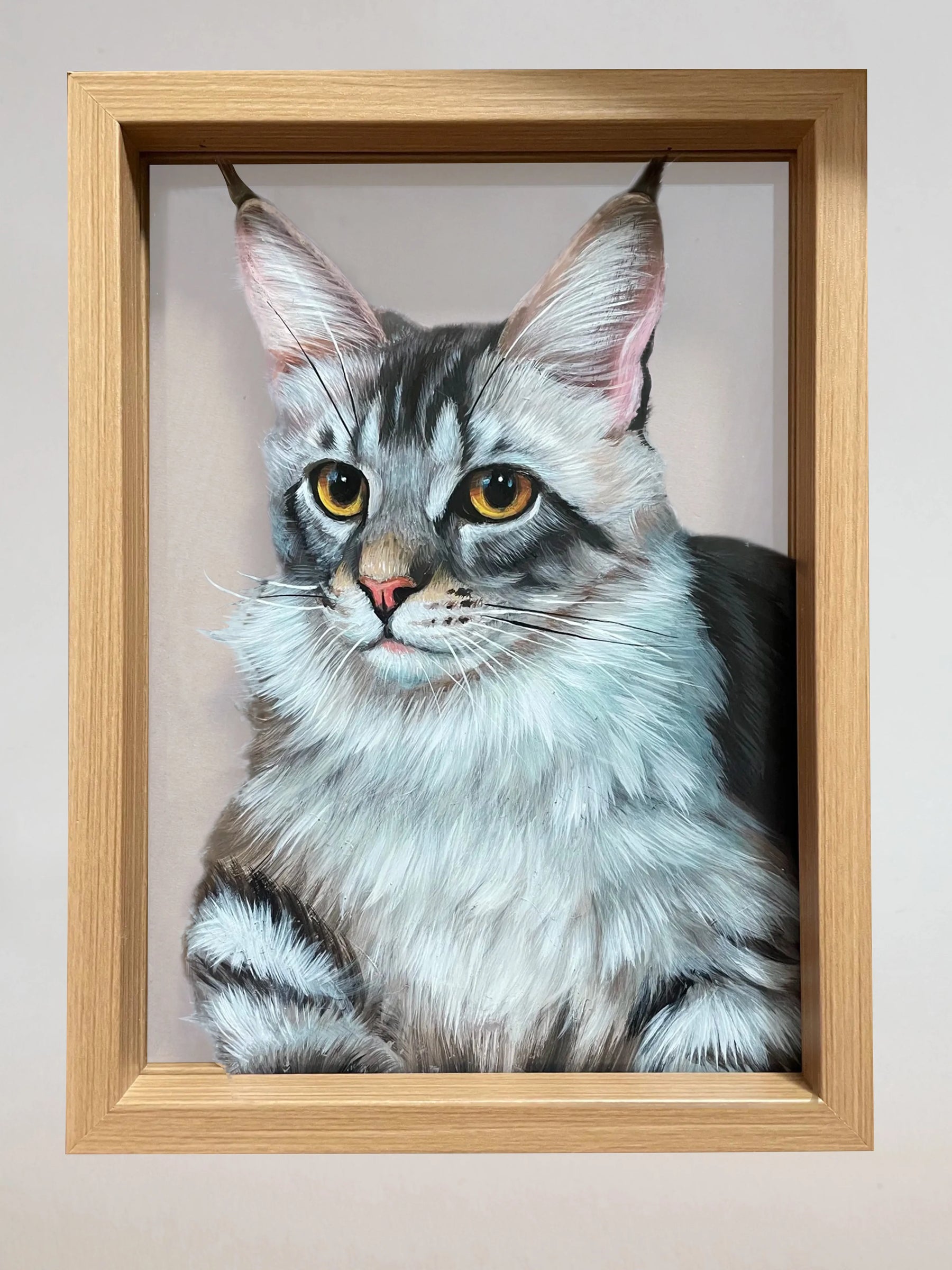
Custom Hand-Painted Pet Portrait with Frame
This is the clearest choice for someone who wants a finished portrait that can be displayed immediately. The official listing describes it as painted on glass, framed, photo-accurate, customizable, and suitable for either a gift or memorial.
- Listed starting price: $169.99
- Format: Hand-painted pet portrait on glass with frame
- Standard use: Wall, shelf, desk, gift, or memorial display
- Listed sizes: 4 × 6, 6 × 6, 5 × 7, 7 × 7, 6 × 8, 8 × 8, 8 × 10, and 8 × 12 inches
- Customization: Size, pose, full-body requests, and multiple-pet options may be available
- Approval: The product page states that a finished-piece photo is sent for confirmation before shipping
- Average creation estimate shown in the product FAQ: Approximately 2–4 weeks, depending on complexity and order queue
Choose this when: The portrait is an anniversary, birthday, memorial, housewarming, or family gift and you do not want the recipient to arrange separate framing.
View the framed hand-painted portrait
Custom Pet Oil Painting from Photo on Glass
This option emphasizes the glass surface and dimensional visual effect. PetDecorArt describes the portrait as hand-painted on glass, made from a pet photograph, and customizable for multiple pets or full-body compositions.
- Listed starting price: $199.99
- Material: Hand-painted pet portrait on glass
- Visual style: Luminous clarity with a dimensional or 3D effect
- Listed sizes: 4 × 6, 6 × 6, 5 × 7, 7 × 7, 6 × 8, 8 × 8, 8 × 10, and 8 × 12 inches
- Default listing: One-pet headshot
- Listed full-body add-on: $40 per pet
- Listed additional-pet add-on: $99 per pet
- Consultation: The official process includes photo upload, order review, one-to-one consultation, creation, and delivery
Choose this when: You prefer clean contemporary decor and want the portrait itself to feel more dimensional than a standard printed canvas.
View the glass oil portrait
Custom Pet Portrait Oil Painting Phone Case
A wall portrait is not the only format that can be physically hand-painted. PetDecorArt’s listing describes this phone case as featuring hand-painted oil artwork rather than a digital print.
- Listed starting price: $69.99
- Artwork: Custom hand-painted pet portrait based on an uploaded photo
- Case construction: Hard shell with a transparent back
- Protection: Listed as scratch- and yellowing-resistant with raised edges
- Compatibility: Options for iPhone, Samsung, and other listed phone models
- Design: Slim, lightweight, and precision-cut for the selected device
- Packaging: The listing states that the case arrives in protective gift-ready packaging
Choose this when: You want an everyday personalized gift rather than a formal memorial or home-display piece.
View the hand-painted phone caseWhy genuinely hand-painted pet portraits cost more
The customer is not only paying for paint and a surface. The price may include reference review, composition planning, color matching, drawing, layering, detail work, revision, approval, drying, framing, protective packing, and the risk involved in producing a one-of-a-kind custom item.
PetDecorArt’s existing dog portrait cost guide places hand-drawn and hand-painted portraits in a broad market range of approximately $90 to $1,500 or more. That range is intentionally wide because a small studio portrait and a large original by an established independent artist are not equivalent purchases.
| Price factor | Why it changes the workload | What to confirm before ordering |
|---|---|---|
| Portrait size | Larger work requires more surface preparation, paint, detail, handling, drying space, and protective packaging. | Whether the listed measurement includes the frame or only the painted area |
| Number of pets | Each additional face requires separate proportion, color, expression, and marking work. | The added cost per pet and how the composition will be arranged |
| Headshot versus full body | A full-body portrait requires posture, legs, paws, tail, body proportions, and more background planning. | Whether the standard price includes only the head and shoulders |
| Background complexity | A simple neutral background is faster than a detailed garden, home, beach, or landscape. | Whether background changes are included or charged separately |
| Reference-photo repair | Blurry, dark, cropped, or damaged images require more interpretation and may reduce certainty. | Whether the artist approves the photos before production begins |
| Framing | Frames add material, assembly, weight, packaging, and shipping cost. | Whether the frame is included and what its external dimensions are |
| Revision policy | Custom corrections require additional artist and support time. | How many adjustments are included and at which stage they can be requested |
| Rush production | The studio may need to change its queue or use faster shipping. | Whether the promised date includes production, approval, and transit |
A low starting price may apply only to a small one-pet headshot. Compare the final configured price rather than comparing one seller’s base price with another seller’s fully framed, multi-pet total.
How long a real hand-painted portrait should take
A portrait does not become authentic simply because it takes several weeks, and a small portrait does not become fake because an experienced artist paints it quickly. However, a genuine custom painting normally involves more than uploading a photograph and receiving a parcel two days later.
A complete order may include:
- Order review and photo assessment
- Clarification of pose, crop, background, and markings
- Composition or outline preparation
- Initial color and shape work
- Layering and detailed painting
- Drying or setting time appropriate to the materials
- Finished-piece review and customer approval
- Framing or product assembly
- Protective packing and shipping
PetDecorArt’s hand-painted product FAQ currently states that an average custom order takes about two to four weeks to complete, depending on complexity and the current queue. Its broader shipping policy provides longer end-to-end estimates for custom handmade products because those estimates also account for confirmation, crafting, and delivery.
Red flags in a “hand-painted” pet portrait listing
The product description avoids naming the medium
Phrases such as “premium artwork,” “museum look,” and “painted effect” sound impressive but do not explain whether the portrait is oil, acrylic, watercolor, digital, printed, or mixed media.
Every product image looks perfectly identical
Consistent presentation is normal, especially when a seller uses professional lighting. However, dozens of supposedly original portraits with identical texture, edge treatment, highlights, and brush patterns deserve closer inspection.
The seller promises nearly instant production
Fast work is possible for small, simple portraits, but a listing that promises detailed, large, multi-pet oil paintings within hours may be describing a digital process rather than a physical painting process.
The listing changes terms throughout the page
Watch for a headline that says “hand-painted,” specifications that say “printed canvas,” and an FAQ that refers to a “digital design.” Mixed terminology may reflect careless copy or a materially different product.
The seller cannot answer whether a printed base is used
A mixed-media product can be valuable, but the seller should be able to describe it plainly. Repeatedly avoiding a simple production question is more concerning than the production method itself.
There is no opportunity to confirm the finished custom piece
Approval is especially important for memorial portraits, unusual markings, multiple pets, and expensive commissions. A no-preview policy is not proof of a scam, but it places more risk on the buyer.
The refund language does not match a custom product
Personalized products often have stricter cancellation and return rules once work begins. Read the policy before ordering and save a copy of the product description, selected options, reference images, and order notes.
How to care for a hand-painted pet portrait
Care depends on the medium and surface, so follow the seller’s product instructions first. The following habits are suitable for most custom display pieces.
- Keep the portrait away from prolonged direct sunlight.
- Avoid bathrooms, damp basements, and areas with rapid humidity changes.
- Do not spray household cleaner directly onto the artwork.
- Dust the frame gently with a clean, soft, dry cloth.
- Do not press, scratch, or rub visible painted areas.
- Handle glass and framed work by the edges or frame rather than the center.
- Keep the original protective packaging in case the portrait must be moved.
- Photograph the artwork and order information for your records.
For a painted phone case, avoid abrasive cleaning tools and harsh chemicals. Remove grit before wiping the surface so small particles do not drag across the artwork.
The most honest labels for common pet portrait products
Sellers do not need to force every product into the same category. Clear, specific labels make it easier for customers to choose the right format.
| Production method | Clear customer-facing label | Wording to avoid |
|---|---|---|
| Paint physically applied to the final surface | Original hand-painted pet portrait | Digitally painted print |
| Digital artwork printed onto canvas | Custom digital pet portrait on canvas | Hand-painted canvas original |
| Printed base with added manual paint | Hand-embellished mixed-media pet portrait | 100% hand-painted original |
| AI-generated image printed on paper or canvas | AI-assisted custom pet portrait print | Painted by a professional artist |
| Original painting photographed and reproduced | Fine-art print of an original hand-painted portrait | Original hand-painted portrait |
| Physical painting created by several studio artists | Studio hand-painted pet portrait | Painted personally by a named artist who did not create it |
Accurate labeling does not reduce the value of digital or mixed-media artwork. It gives the buyer enough information to judge originality, texture, price, delivery time, and emotional significance on the correct terms.
Frequently asked questions
What does a hand-painted pet portrait mean?
It should mean that a human artist physically applies paint by hand to the final surface you receive. A digital image that is printed onto canvas, glass, paper, or another product should be described as a print rather than a fully hand-painted original.
Is a digital pet portrait hand-painted?
A digital portrait may be manually created by an artist using a stylus, but it is digitally painted rather than physically hand-painted. When printed, it should normally be sold as a digital pet portrait print.
Can an artist trace or project my pet photo and still call the portrait hand-painted?
Yes. Tracing or projection can be used to establish accurate proportions. The portrait can still be genuinely hand-painted when the visible final image is physically created with manually applied paint.
Is a print with added brushstrokes considered hand-painted?
It is more accurately described as hand-embellished or mixed media. Added brushstrokes do not turn a printed photographic or digital base into a completely hand-painted original.
Can AI be used in a hand-painted pet portrait process?
AI may be used to explore a background or prepare a reference composition before an artist paints the final physical piece. However, an AI-generated image that is simply printed should not be represented as an original hand-painted portrait.
Does a smooth surface mean the pet portrait is printed?
No. Some painters use thin layers and fine detail work, especially on glass, resulting in a smooth appearance. Production details, progress evidence, and seller disclosure are more reliable than texture alone.
How can I ask a seller whether a portrait is really hand-painted?
Ask whether the visible image is physically painted directly onto the final object or whether a printed image is used as the base. Also ask what paint and surface are used.
Should I request a painting-process video?
A process video is strong evidence, but not every affordable studio can film each order. Stage photographs, clear material descriptions, close-ups, customer-photo comparisons, and a finished-piece approval process can also provide useful verification.
Why do hand-painted pet portraits take several weeks?
The process can include photo assessment, consultation, composition, manual painting, layering, detail work, drying, approval, framing, packing, and shipping. Complexity and the studio’s current queue also affect timing.
What is the best photo for a hand-painted pet portrait?
Use a sharp, well-lit photo taken near the pet’s eye level. The eyes, nose, ears, coat color, and important markings should be visible. Multiple angles are especially helpful for full-body or multi-pet portraits.
Can a hand-painted portrait include more than one pet?
Yes. Many artists can combine pets from separate photographs. Send images taken from similar angles when possible, explain the pets’ relative sizes, and confirm the added price before production begins.
Are hand-painted pet portraits suitable for memorials?
Yes. A physical original can work especially well as a memorial because it is made for one animal and one family. Provide several reference photos and explain which expression, markings, or senior-pet features should be preserved.
Are glass pet portraits really painted by hand?
They can be. Glass is the surface rather than the production method. A portrait is hand-painted when an artist physically applies the paint to the glass. Check the individual product description for confirmation.
What should I do if the delivered portrait appears to be printed?
Do not scratch or chemically test the surface. Photograph the artwork in natural light, save the original listing, and ask the seller to clarify the production method. If the item materially differs from its description, follow the seller’s documented quality-issue or dispute process.
Choose the production method before choosing the style
Start by deciding what you actually want to receive: an original physical painting, a framed digital print, a hand-embellished piece, a wearable portrait, or a three-dimensional keepsake. Once the format is clear, compare the artist process, photo requirements, approval policy, size, timeline, and complete configured price.
View hand-painted pet portrait options Compare all custom pet portrait styles Read the complete portrait selection guide

