
A custom cat portrait can turn an ordinary phone photo into framed artwork, a handmade wool keepsake, a digital illustration, or even a three-dimensional replica. The difficult part is not finding someone who can draw a cat. It is choosing a style, price level, and reference photo that preserve the details that make your cat immediately recognizable.
This guide compares the most common custom cat portrait styles, explains what different price levels usually include, shows how to take a better reference photo, and provides a practical checklist for reviewing the finished artwork.
Quick Answer
For most cat owners, the best starting point is a clear head-and-chest photo taken near a window, with both eyes and ears visible and the coat shown in its true color. Choose a digital or printed portrait for a lower-cost gift, a hand-painted framed portrait for traditional wall art, a wool-felt portrait when fur texture matters most, or a full-body sculpture when posture, paws, and tail are part of your cat’s identity.
Current prices vary widely. Simple digital portraits may cost less than $40, handmade watercolor portraits often begin around $70, professional original paintings may start near $300, and detailed handmade three-dimensional portraits can cost $250 to $500 or more.
Before ordering, confirm the medium, physical size, number of cats included, proof or revision process, creation time, shipping time, and whether the artist can work from more than one photo.

What Makes a Custom Cat Portrait Successful?
A successful portrait should look like one particular cat, not simply a realistic tabby, Siamese, Maine Coon, Persian, or domestic shorthair. The difference usually comes from a small group of identity details.
The Cat Identity Map
| Identity feature | What the artist should preserve | What can make the portrait feel wrong | Best supporting photo |
|---|---|---|---|
| Eyes | Shape, spacing, color, pupil size, eyelid angle, and direction of gaze | Making every cat’s eyes larger, rounder, brighter, or more symmetrical | A sharp close-up in soft natural light |
| Ears | Height, width, angle, tufts, folds, nicks, and uneven positioning | Straightening an ear tilt or removing a familiar notch | A front or three-quarter view with both ears visible |
| Muzzle and whisker pads | Width, roundness, chin shape, nose placement, and whisker direction | Using a generic small triangular muzzle for every cat | A close-up taken at the cat’s eye level |
| Coat pattern | Tabby stripes, facial markings, color patches, points, spots, and chest color | Replacing individual markings with a breed-standard pattern | An evenly lit photo showing true color |
| Head shape | Cheek width, forehead shape, jawline, nose length, and fur volume | Making a narrow-faced cat too round or flattening a broad face | A direct front view without lens distortion |
| Expression | Relaxed, alert, sleepy, cautious, curious, annoyed, or playful character | Giving every cat the same cheerful or wide-eyed expression | The photo family members say “looks most like them” |
| Body and posture | Leg length, chest width, paw position, tail shape, and sitting style | Using generic body proportions based only on breed | A full-body side or three-quarter photo |
The strongest portrait artists understand that accuracy is not the same as perfection. A slightly lower ear, cloudy eye, shortened tail, torn ear tip, crooked whisker, or uneven facial marking may be the feature the owner recognizes first.
Surface Detail Is Not the Same as Likeness
A portrait can contain carefully rendered fur and still fail to look like your cat. Surface detail includes individual hairs, glossy eyes, highlights, whiskers, and shadows. Likeness depends on the placement and proportions underneath those details.
Check the eyes, ear angles, nose position, muzzle width, facial markings, and head silhouette before judging the amount of fur detail. When the structure is correct, the portrait usually feels familiar even when the artist uses visible brushwork or a simplified background.
Custom Cat Portrait Styles Compared
The right style depends on the result you want, the photo you have, your budget, and where the finished portrait will be displayed.
| Style | Visual result | Best for | Photo requirements | What to confirm |
|---|---|---|---|---|
| Digital illustration | Clean, flexible, and easy to reproduce in several sizes | Affordable gifts, social media images, prints, and fast delivery | One clear face photo may be enough | Whether it is individually illustrated or made with a preset filter |
| Watercolor | Soft edges, light color washes, and an airy background | Gentle memorials, bright interiors, and expressive close-ups | Sharp facial details with clear coat colors | Whether the artwork is an original painting or a printed digital watercolor |
| Colored pencil | Precise eyes, whiskers, markings, and individual hairs | Close-up realism and cats with complex facial patterns | A high-resolution image with sharp eyes and nose | Paper size, framing, and background options |
| Acrylic or oil painting | Rich color, visible brushwork, depth, and a traditional art feel | Statement wall art, memorial portraits, and heirloom gifts | One strong primary image plus color references | Surface material, frame, proof process, drying time, and shipping protection |
| Hand-painted glass portrait | Luminous color with a clean and modern presentation | Wall displays, shelves, desks, and finished gift-ready art | A sharp face or head-and-chest photograph | Whether a frame is included and whether the painting is flat or dimensional |
| Wool-felt framed portrait | Soft three-dimensional fur, visible volume, and tactile texture | Long-haired cats, memorial keepsakes, and texture-focused portraits | Several photos showing face shape, coat, chest, and ears | Head-only or half-body format, frame size, materials, and revisions |
| Full-body wool sculpture | A freestanding three-dimensional replica | Distinctive posture, paws, tail, body shape, and premium memorial pieces | Front, side, rear, and full-body photos are strongly recommended | Finished height, support base, materials, revisions, and safe display requirements |
| Embroidered portrait | Thread-based texture on clothing, hats, bags, or fabric art | Wearable gifts and simpler graphic portraits | A clean photo with a readable silhouette | Embroidery method, thread detail, garment material, and washable care instructions |
| Novelty or themed portrait | Your cat placed in royal clothing, a movie-inspired scene, or another playful concept | Humorous gifts and decorative statement pieces | A clear face photographed from a compatible angle | Whether the face will be illustrated, painted, or simply placed into a template |
How to Choose the Right Cat Portrait Style
Start With What You Want to Preserve
- Choose a face portrait when your cat’s eyes, ears, facial markings, and expression carry most of their personality.
- Choose a half-body portrait when the chest ruff, front paws, bib marking, collar, or sitting pose matters.
- Choose a full-body portrait when the tail, body proportions, leg length, loaf position, or recognizable posture is important.
- Choose wool felt when fluffy cheeks, long fur, a thick ruff, ear tufts, or coat volume is central to the likeness.
- Choose paint or pencil when detailed markings, eye color, and facial structure are the main priorities.
Match the Style to the Photo You Actually Have
A sharp, well-lit close-up can support almost any style. A small, blurry, or old photograph may work better as a soft watercolor, painterly portrait, or simplified illustration than as an ultra-detailed photorealistic piece.
| Your best available photo | Strong style choices | Styles needing more references | Recommended next step |
|---|---|---|---|
| Sharp face photo in natural light | Painting, pencil, glass portrait, digital, watercolor | Full-body sculpture | Add one side view and one full-body photo if possible |
| Clear full-body sitting photo | Full-body sculpture, painting, illustration | Extreme facial close-up realism | Add a sharp face close-up for the eyes and muzzle |
| Old printed photograph | Painterly, watercolor, simplified digital, memorial composition | Highly detailed pencil or sculpture | Scan the original rather than photographing the print |
| Dark indoor black-cat photo | Painterly portrait if supporting images exist | Photorealistic work based on one image | Provide a daylight photo showing muzzle and coat structure |
| Photo with cropped ears or paws | Close-up head portrait | Half-body or full-body formats | Provide another image showing the missing anatomy |
| Funny sleeping or curled pose | Illustration, painting, full-body felt portrait | Formal front-facing portrait | Tell the artist whether the pose or facial likeness is the priority |
Consider the Display Location
A framed portrait fits naturally on a wall, console, desk, or bookshelf. A full-body sculpture needs a stable surface protected from curious pets, children, dust, and direct sunlight. A wearable brooch or keychain may be a better choice when the recipient does not have room for another wall item.
Before ordering, measure the intended location. A 4 × 6-inch portrait may work on a desk but feel too small on an open living-room wall. A 12- or 16-inch dimensional portrait may require more visual and physical space than a flat print with the same outer measurements.
For room-specific ideas, see PetDecorArt’s cat art for home decor guide and pet portrait size guide.
How Much Do Custom Cat Portraits Cost?
Custom cat portrait prices range from inexpensive digital downloads to original fine-art commissions and large handmade sculptures. The term “custom portrait” alone does not tell you whether you are buying a downloadable file, a printed template, an original painting, a framed object, or a three-dimensional handmade piece.
The table below uses live public examples checked on July 23, 2026. These are price snapshots rather than guaranteed market averages.
| Portrait type | Public price example | What the example includes | Best for | Source |
|---|---|---|---|---|
| Digital portrait download | Many current examples under $40 | Digital artwork or downloadable file; printing may be separate | Lower budgets and fast gifts | View current Etsy examples |
| Template-based canvas portrait | From approximately $39 in one current store example | Photo adapted to a selected design and canvas format | Decorative or novelty wall art | View PopArtYou pricing |
| Handmade watercolor | $70 to $190 in one current artist’s size range | Original watercolor in sizes from 5 × 7 to 16 × 20 inches | Soft handmade art and memorial gifts | View watercolor pricing |
| Professional original painting | From $300 in one current artist example | Original painting on wood panel or canvas, with price increasing by size and complexity | Fine-art commissions and heirloom wall pieces | View artist pricing |
| Framed hand-painted glass portrait | From $169.99 at PetDecorArt | Hand-painted glass artwork with frame and multiple size choices | Ready-to-display wall or shelf art | View PetDecorArt product |
| Framed 3D wool-felt portrait | From $249.99 at PetDecorArt | Handmade head or half-body portrait in a wooden frame | Textured keepsakes and memorial pieces | View PetDecorArt product |
| Full-body wool-felt portrait | From $499.99 at PetDecorArt | Handmade full-body replica in several height ranges | Premium sculpture and posture-focused likeness | View PetDecorArt product |
For a more detailed breakdown of current cat painting prices, see How Much Does It Cost to Get Your Cat Painted?
What Changes the Final Price?
| Price factor | Why it matters | Question to ask before ordering |
|---|---|---|
| Digital versus physical artwork | A digital file does not include printing, framing, packaging, or physical materials | Will I receive a download, print, canvas, original painting, or framed object? |
| Handmade versus automated production | Individual painting, drawing, felting, or sculpting requires more labor | Is the artwork created by hand, digitally illustrated, or generated from a preset effect? |
| Size | Larger artwork requires more material, detail, finishing, and shipping protection | Is the displayed price for the smallest available size? |
| Number of cats | Each cat adds facial detail, markings, scale decisions, and composition work | How much does each additional cat cost? |
| Head, half-body, or full-body | Full-body artwork requires accurate paws, legs, posture, chest, and tail | Is full-body customization included or charged separately? |
| Background | Rooms, landscapes, furniture, plants, and decorative scenes add work | Are plain, transparent, or softly painted backgrounds included? |
| Frame or display base | Framing adds cost, weight, and protective packaging | Does the price include the frame, stand, or base shown in the photographs? |
| Proofs and revisions | A collaborative approval process requires additional artist and service time | How many revision rounds are included, and when will I see the artwork? |
| Rush production | Fast deadlines may require priority scheduling or expedited shipping | Is the delivery date guaranteed before I place the order? |
| Photo restoration | Old, damaged, dark, or blurry images may require additional interpretation | Will the artist review my photo before production begins? |
How to Take a Better Photo for a Custom Cat Portrait
You do not need professional equipment. A phone camera, soft window light, and a patient moment are usually enough.

Use the Three-Photo Reference Pack
Instead of uploading a large folder of unlabeled images, select three photographs with specific roles.
- Primary portrait photo: controls the pose, expression, head angle, and crop.
- Color and marking photo: shows the most accurate eye color, coat tone, stripes, patches, nose color, and chest markings.
- Structure photo: shows the side profile, ears, chest, paws, body proportions, or tail that may be unclear in the primary image.
Label the photos in your order notes. For example: “Photo one controls the face and expression. Photo two shows the correct green eye color. Photo three shows the full tail.”
Photograph Near the Cat’s Eye Level
Photos taken from directly above can make the head appear larger, shorten the body, hide the chest, and change the apparent angle of the eyes and ears. Lower the camera toward the cat’s face instead of always photographing while standing.
For a full-body portrait, include at least one photo taken from the side or at a low three-quarter angle. This helps the artist understand leg length, chest depth, tail position, and overall posture.
Focus on the Eyes

The eyes influence the entire expression. Before taking the picture, tap the nearer eye on your phone screen to focus. Take several photographs rather than trusting one frame.
Avoid forcing the cat to stare directly into a bright light. Soft side light often creates a more natural expression and preserves eye color without narrowing the pupils excessively.
Keep Both Ears in the Frame
Portrait crops frequently cut off ear tips, especially with tall-eared cats. Leave extra room around the head when taking the photograph. The artist can crop later, but cannot accurately restore a missing ear without another reference.
Avoid Direct Flash
Flash can create bright eye reflections, flatten coat texture, wash out pale markings, and produce a color that does not match the cat in person. Use a bright room, an open doorway, or indirect window light instead.
Use a Background That Separates From the Coat
- Photograph a black cat against a light or medium neutral background.
- Photograph a white cat against a gray, tan, blue, or other slightly darker background.
- Avoid patterned blankets when the cat also has complex markings.
- Move bright toys, cords, dishes, and clutter away when possible.
The final portrait can still use a different background. A simple photo background merely helps the artist see the cat’s outline and fur edges.
Preserve True Coat Color
Disable heavy filters, portrait effects, beauty modes, and automatic color presets. Warm indoor bulbs can make gray fur look brown, while cool light can make cream fur appear blue.
Include at least one unedited daylight photo, even when another image has the expression you prefer.
Capture Whiskers Without Making Them the Only Priority
Whiskers are important, but a photograph does not need every whisker to appear perfectly sharp. The artist mainly needs to understand their direction, length, color, and density. Eye shape, muzzle structure, and coat markings usually matter more to the overall likeness.
PetDecorArt also provides a dedicated custom cat portraits page with a quick photo checklist and style-selection guidance.
Can a Weak, Blurry, or Old Cat Photo Still Work?
Sometimes. The answer depends on what information is missing and whether supporting photos can replace it.
| Photo problem | What is missing | Possible solution | Best portrait approach |
|---|---|---|---|
| Eyes are slightly blurry | Eye shape, color, and highlights | Use a second close-up taken from a similar angle | Painting, watercolor, or illustrated realism |
| One ear is cropped | Ear height, edge, tufts, and angle | Provide a front-facing supporting photo | Head portrait if the missing ear cannot be confirmed |
| Photo is dark | Muzzle structure, fur direction, and markings | Add a daylight image for color and anatomy | Painterly portrait rather than false photorealism |
| Only an old printed photo remains | Fine detail and reliable color | Scan the print at high resolution and provide written color notes | Soft painting, watercolor, or memorial composition |
| Photo has strong flash reflection | Natural eye appearance | Use another image to confirm eye color and pupil shape | Most styles if supporting references are available |
| Cat is partly hidden by a blanket | Chest, paws, legs, or tail | Use the image for the face only and add full-body references | Head portrait or carefully planned full-body work |
| Harness or collar covers the neck | Hidden fur and markings | Provide another photo without the accessory | Keep the accessory unless the missing area can be reconstructed |
| Cat is no longer living and only one photo exists | Multiple views and exact hidden anatomy | Choose a composition close to the original photograph | Painterly or framed portrait using honest interpretation |
Photo Tips for Difficult Cat Coat Colors and Patterns
Black Cats
Black fur often becomes one dark shape in a phone photograph. The eyes remain visible, but the cheeks, muzzle, chest, and ear edges disappear.
- Use indirect daylight rather than direct flash.
- Choose a background lighter than the coat.
- Tap the face on the screen and slightly reduce exposure if the phone turns the coat gray.
- Take one side-lit image to reveal the cheek and chest structure.
- Include a separate image showing whether the coat is neutral black, warm black, blue-black, or brown in sunlight.
More detailed help is available in PetDecorArt’s black cat photo guide .
White and Cream Cats
White coats can lose their shape when photographed against a bright wall or window. The fur may appear as a blank white area without cheeks, chest, or ear edges.
- Use open shade or indirect window light.
- Select a medium-toned background.
- Avoid overexposing the image to make the coat look cleaner.
- Preserve subtle gray, cream, tan, or cool tones in the fur.
Tabby Cats
Tabby markings are rarely perfectly symmetrical. Ask the artist to preserve the actual forehead pattern, cheek lines, eye markings, leg bands, and tail rings rather than using a generic tabby design.
Include one direct face photo and one side view. The face photo controls the expression, while the side view shows the stripe direction across the shoulders and body.
Tortoiseshell and Calico Cats
Complex patches can be simplified unintentionally. Take photographs in neutral daylight and avoid strong warm filters. Clearly identify the patch crossing the nose, the colors around each eye, and any split-face pattern.
When the portrait is small, ask which markings can remain readable at the selected size. A larger format may be worthwhile when the coat pattern is the main source of recognition.
Colorpoint Cats
Siamese, Ragdoll, Himalayan, and other colorpoint cats may appear dramatically different under warm and cool lighting. Provide one image showing the most accurate body color and another showing the face mask, ears, paws, and tail.
Long-Haired Cats
Fur volume changes the apparent shape of the head and body. Include photographs taken before and after grooming only when both appearances are familiar. Tell the artist which coat length should control the finished portrait.
Side lighting helps reveal ruffs, cheek fluff, ear tufts, feathering, and tail volume. This is particularly useful for wool-felt portraits.
Senior Cats
Gray hairs, cloudy eyes, a thinner face, worn ear edges, and a softer posture may be emotionally important. Tell the artist whether these features should remain.
How to Order a Multi-Cat Portrait
A portrait containing two or more cats requires more than separate face photos. The artist also needs information about scale, preferred placement, and the relationship between the cats.
Provide One Clear Photo Per Cat
Each cat should have a sharp primary image. A group photograph is useful for showing relative size and how the cats sit together, but it may not contain enough facial detail for every subject.
Explain Relative Size
Do not assume the artist can determine size from unrelated photographs. State which cat is taller, heavier, smaller, younger, or longer-haired.
Choose a Larger Finished Size
Adding cats to the smallest available size reduces the room available for eyes, markings, whiskers, and coat texture. Ask the artist which size is appropriate for the number of faces and the desired viewing distance.
Decide Whether the Cats Need to Appear Together Naturally
When the cats were never photographed together, a formal side-by-side composition is often more believable than attempting to create a close interaction that did not exist in the source images.
What to Tell the Artist
A useful order note identifies visual priorities. The artist does not need a long biography before understanding which photo controls the portrait and which details must remain unchanged.
Include These Details
- Which photograph is the primary reference
- Whether you want head-only, half-body, or full-body artwork
- The correct eye color and coat color
- Facial or body markings that must remain exact
- Whether the collar, tag, bow, harness, or clothing should stay
- Whether scars, ear notches, gray hairs, or cloudy eyes should stay
- Whether the original background should be removed or simplified
- Whether the artist may combine information from several photos
- The relative size of each cat in a multi-cat portrait
- Your required date when the portrait is a gift
Copy-and-Paste Cat Portrait Brief
Please use photo one for the pose, head angle, and expression. Photo two shows the most accurate green eye color and orange coat tone. Photo three shows the full chest and tail.
Please preserve the darker patch above the right eye, the small notch in the left ear, and the white chin. Remove the background and use a simple warm neutral color. Please do not enlarge the eyes or make the facial markings symmetrical.
For more ordering help, read How to Order a Custom Pet Portrait .
Recommended PetDecorArt Options for Custom Cat Portraits
PetDecorArt offers several handmade formats for buyers who want more than a basic digital print. The following product details and prices were checked on July 23, 2026. Prices may change when you select a larger size, half-body format, additional cats, or another customization option.

Best All-Around Wall Portrait: Framed Hand-Painted Portrait on Glass
This is the most straightforward PetDecorArt option for a cat owner who wants a finished, framed portrait rather than a digital file. It works especially well when the face, eyes, ear shape, and coat markings are the main priorities.
- Starting price checked: $169.99
- Method: Hand-painted on glass
- Presentation: Frame included and ready for display
- Sizes listed: 4 × 6, 5 × 7, 6 × 6, 6 × 8, 7 × 7, 8 × 8, 8 × 10, and 8 × 12 inches
- Customization: Size, pose, and multiple-pet options are listed
- Preview process: The product page states that a finished-piece photo is sent for confirmation before shipping
- Average completion estimate: Approximately 2–4 weeks, depending on complexity and the current queue
Choose this when: you want recognizable wall art, prefer a finished frame, and have a strong face or head-and-chest photo.
View the Framed Hand-Painted Portrait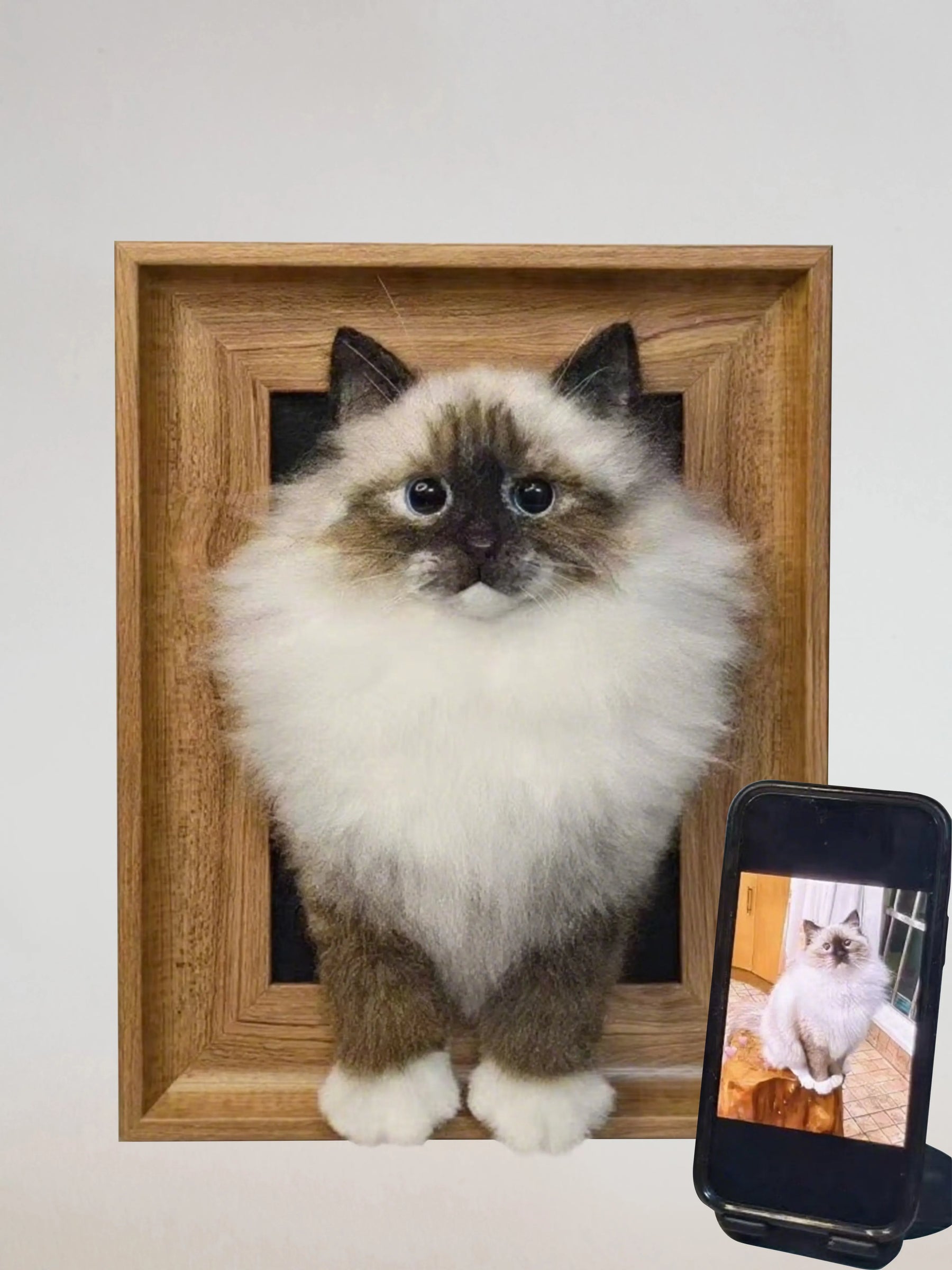
Best for Fur Texture: Framed 3D Wool-Felt Cat Portrait
This format is a strong match for long-haired cats, prominent chest ruffs, rounded cheeks, ear tufts, and other features that depend on physical volume. The artwork extends forward from the frame rather than remaining completely flat.
- Starting price checked: $249.99
- Method: Handmade wool-felt portrait
- Composition options: Head-only or half-body
- Frame sizes listed: 6, 7, 8, 10, 12, and 16 inches
- Revision policy listed: Unlimited revisions with one-to-one custom service
- Personal-material option: The product page states that real whiskers or fur may be included
- Materials listed: Wool body with glass eyes and selected resin, clay, or wax details
- Production estimate: Approximately 15–30 days
Choose this when: your cat’s coat shape is central to their identity or you want a highly tactile memorial keepsake.
View the Framed Wool-Felt Portrait
Best Premium Keepsake: Full-Body Wool-Felt Cat Portrait
A full-body portrait preserves more than the face. It can show a familiar sitting position, short or long legs, paw placement, chest shape, tail direction, and overall silhouette.
- Starting price checked: $499.99
- Method: Full-body handmade needle-felted portrait
- Sizes listed: 6–8, 8–10, 10–12, 12–14, and 14–16 inches
- Customization: Created from the customer’s cat photographs
- Revision policy listed: Unlimited revisions with one-to-one service
- Production estimate: Approximately 15–30 days
Choose this when: your cat’s posture, paws, tail, body shape, or familiar sitting position matters as much as the face.
View the Full-Body Wool Portrait
Best Lower-Cost Handmade Keepsake: Mini Wool-Felt Cat Keychain
A miniature keychain or bag charm is a practical option when you want something handmade and personal without ordering a large framed or full-body piece.
- Price checked: $59.90
- Method: Handmade three-dimensional wool-felt portrait
- Approximate size: 1.5 inches, or about 4 cm
- Use: Keys, bags, backpacks, zipper pulls, or small displays
- Production estimate: Approximately 15–30 days
Choose this when: you want a portable gift, have limited display space, or prefer a handmade option under $100.
View the Mini Cat Keychain
Best Wearable Memorial Option: Wool-Felt Cat Portrait Brooch
The brooch is designed as a small wearable portrait rather than traditional wall art. It can be attached to clothing, a bag, or displayed in a small keepsake area.
- Price checked: $99.99
- Method: Handmade wool felt
- Design: Three-dimensional face portrait
- Positioning: Lightweight wearable keepsake
- Product focus: Fur texture, expression, and markings
Choose this when: the recipient wants to keep the portrait close without displaying a larger object at home.
View the Wool-Felt Portrait BroochBrowse additional formats through the Custom Cat Portraits guide, Pet Portraits collection, or hand-painted pet portrait collection.
How Long Does a Custom Cat Portrait Take?
A custom portrait timeline may include photo review, order confirmation, artist assignment, creation, proof or progress review, revisions, finishing, framing, packaging, and shipping.
Some PetDecorArt portrait pages give an average completion estimate of approximately two to four weeks. Detailed wool-felt products commonly list approximately 15–30 days of production, while the total delivery estimate may be longer after assessment and shipping are included.
Before ordering for a birthday, holiday, adoption anniversary, memorial service, or other fixed date, confirm:
- Whether the stated timeline covers production only or total delivery
- When the proof or finished preview will be sent
- How quickly you must respond to avoid delays
- Whether revision time is included
- Whether faster production or shipping is available
- Whether the requested date is guaranteed in writing
How to Review the Portrait Proof
Review the portrait systematically rather than deciding only whether it looks attractive.
The 60-Second Cat Portrait Review
- Check the head silhouette. Is the face too wide, narrow, round, flat, or tall?
- Check the eyes. Compare shape, spacing, color, pupil size, and direction of gaze.
- Check the ears. Confirm their height, angle, edge shape, tufts, folds, and notches.
- Check the nose and muzzle. Look at nose placement, whisker-pad width, chin shape, and mouth line.
- Check the markings. Compare forehead stripes, eye lines, nose patches, chest color, paws, and tail.
- Check coat texture. Does the fur look short, plush, wiry, silky, fluffy, or layered in the correct areas?
- Check requested details. Confirm the collar, tag, scar, gray hair, cloudy eye, name, and dates.
- Check the crop and background. Make sure the orientation and composition fit the intended display space.
Write Specific Revision Notes
| Vague note | More useful revision note |
|---|---|
| The face does not look right. | The cheeks appear wider than in the primary photo. Please narrow the lower face without changing the forehead. |
| The eyes are wrong. | The right eye should be slightly narrower, and both eyes should be a softer yellow-green rather than bright green. |
| The markings are inaccurate. | Please widen the orange patch above the left eye and move the white nose stripe slightly toward the right. |
| The color looks strange. | Please use photo two for coat color. The fur should be a cooler gray rather than brown-gray. |
| Make it more realistic. | Please soften the hard outline around the ears and add more visible fur direction around the cheeks and chest. |
| It does not look like her. | Please preserve the lower left ear and the wider right whisker pad. Those are the features our family recognizes first. |
Separate genuine corrections from new requests. Correcting the wrong eye color is different from replacing the background, changing the pose, adding another cat, or switching from a head portrait to a full-body portrait.
Common Mistakes When Ordering a Custom Cat Portrait
Choosing the Cheapest Listing Without Checking the Format
A low price may cover only a digital file. Printing, framing, shipping, extra cats, and larger sizes may cost more.
Using the Cutest Photo Instead of the Most Useful Photo
A sleeping, yawning, or curled-up photograph may be emotionally meaningful but hide the eyes, ears, paws, or body structure. Use it as the primary reference only when the pose itself is the main reason for ordering.
Sending Too Many Unlabeled Photos
Twenty unrelated images can introduce conflicting eye colors, coat tones, ages, grooming styles, and head angles. Choose one primary photo and label the purpose of each supporting image.
Expecting the Artist to Reconstruct a Full Body From a Headshot
The artist cannot know the exact paws, chest markings, tail length, body proportions, or sitting posture from a facial close-up.
Using Filtered Photos for Color
Filters can change eye color, coat temperature, contrast, and marking boundaries. Always include an unedited image.
Ignoring Size Until After the Artwork Is Finished
A small format may not have enough room for multiple cats, intricate tortoiseshell patches, full-body detail, or a complex background.
Assuming “Custom” Means Hand-Painted
Custom may describe a personalized digital file, a printed filter, a template with the face inserted, or handmade original art. Read the method and materials before ordering.
Approving the Proof Too Quickly
Compare the portrait with the original photographs on a larger screen when possible. Ask another family member who knows the cat well to review the identity details.
Changing the Entire Concept During Revision
Replacing the pose, background, crop, number of cats, or portrait format may require additional work and cost. Confirm the main composition before production begins.
Ordering Too Close to the Gift Date
Handmade work needs time for creation, approval, finishing, and shipping. Place the order early and confirm the deadline before checkout.
Step-by-Step Custom Cat Portrait Ordering Checklist
-
Decide the purpose.
Is the portrait for home decor, a birthday, a holiday, an adoption anniversary, or a memorial? -
Choose the display location.
Measure the wall, desk, shelf, console, or mantel. -
Choose the composition.
Select head-only, head-and-chest, half-body, full-body, or multiple cats. -
Choose the medium.
Compare digital, watercolor, pencil, paint, glass, wool felt, embroidery, and sculpture. -
Review the artist’s portfolio.
Look for cats with similar coat length, coloring, facial shape, and markings. -
Confirm what the price includes.
Check the physical format, size, number of cats, frame, proof, revisions, and shipping. -
Select one primary photograph.
Use it to control the pose, expression, head angle, and crop. -
Add two or three supporting photographs.
Use them to clarify color, markings, ears, body shape, paws, and tail. -
Write a short visual brief.
Identify the details that must remain unchanged and the edits the artist may make. -
Confirm the timeline.
Separate creation time from total delivery time. -
Review the proof in a fixed order.
Check silhouette, eyes, ears, muzzle, markings, coat, requested details, and background. -
Approve the final details.
Confirm size, orientation, name spelling, dates, frame, and shipping address.
PetDecorArt explains its photo review, artist assignment, consultation, creation, preview, and delivery workflow in How PetDecorArt Turns Photos Into Handmade Pet Portraits .
How to Care for the Finished Portrait
Follow the care instructions provided with the finished piece. General precautions include:
- Keep artwork away from long-term direct sunlight.
- Avoid high humidity, condensation, and damp walls.
- Handle glass portraits by the frame or edges.
- Do not spray cleaners directly onto painted or felted surfaces.
- Use a soft, dry cloth on frames and exterior display surfaces.
- Keep wool-felt artwork away from pets that may chew or pull fibers.
- Place full-body sculptures on a stable surface away from high-traffic edges.
- Save the original packaging for moving or long-term storage.
Frequently Asked Questions
What is the best type of photo for a custom cat portrait?
Use a sharp, naturally lit photo taken near the cat’s eye level. Both eyes and ears should be visible, the coat should show its true color, and the face should not be distorted by an extreme close-up. Add supporting photos for markings, body shape, paws, or tail.
How much does a custom cat portrait cost?
Prices range from less than $40 for many digital portrait examples to $70 or more for handmade watercolor, around $300 or more for some professional original paintings, and $250 to $500 or more for detailed three-dimensional handmade portraits. Size, medium, number of cats, framing, and revisions affect the final price.
What is the best style for a custom cat portrait?
Choose a framed painting for traditional wall art, a digital portrait for a lower-cost and flexible option, watercolor for a softer look, wool felt for visible fur texture, or a full-body sculpture when posture, paws, and tail are important.
Can an artist create a cat portrait from a blurry photo?
Sometimes. A blurry photo can guide the pose or expression when sharper supporting photos provide the eye shape, coat color, markings, and anatomy. When no supporting images exist, a painterly or simplified style may be more suitable than extreme photorealism.
Can several cat photos be combined into one portrait?
Yes. Choose one photo to control the pose and expression, then label the purpose of the supporting images. Avoid combining conflicting head angles, ages, lighting conditions, and grooming styles without discussing the composition with the artist.
Can I order a portrait with more than one cat?
Yes. Provide one clear primary photo for each cat, a group photo when available, and written information about their relative sizes and preferred positions. A larger portrait size usually preserves more facial and coat detail.
Should I choose a head portrait or a full-body cat portrait?
Choose a head portrait when the eyes, ears, face, and markings carry most of the cat’s identity. Choose full body when the sitting position, paws, leg length, chest, body shape, or tail is equally important.
How long does a custom cat portrait take?
The timeline depends on the medium and artist. Digital portraits may be completed relatively quickly, while handmade paintings and sculptures may require several weeks. Some PetDecorArt products list approximately two to four weeks, while detailed wool-felt pieces list approximately 15–30 days of production.
Can the artist remove a collar, harness, or background?
Usually, but another photo should show the fur and body area hidden underneath the collar or harness. Background removal is generally easier, although the new background should still provide clear contrast with the cat’s coat.
Are handmade cat portraits better than digital portraits?
Not automatically. Handmade portraits provide a physical original, visible material, and individual craftsmanship. Digital portraits may offer lower prices, faster revisions, flexible backgrounds, and easy reproduction. The better option depends on your budget and the finished format you want.
How do I photograph a black cat for a portrait?
Use soft daylight, avoid direct flash, and place the cat against a lighter neutral background. Focus on the eyes and take an additional side-lit photo that shows the muzzle, cheeks, chest, and direction of the coat.
What should I check before approving the final cat portrait?
Check the head or body silhouette first, followed by the eyes, ears, nose, muzzle, markings, coat texture, requested accessories, background, crop, size, orientation, and any name or date. Send specific correction notes before approving shipment.
Ready to Turn Your Cat’s Photo Into a Portrait?
Start with one clear primary photograph, add two supporting images, and identify the three details that make your cat instantly recognizable. Then choose the material and size that fit your display space and budget.
View the Cat Portrait Selection Guide Shop Custom Pet Portraits Read the Complete Ordering GuidePrice and product information: PetDecorArt prices, dimensions, materials, options, and production estimates were checked against official product pages on July 23, 2026. Public competitor prices are examples observed on the same date and are not universal market averages. Prices and availability may change; review the current product page before ordering.


