
Last updated: July 24, 2026
The quick answer: Choose a framed canvas pet portrait when you want warm texture and lightweight wall art. Choose a glass portrait when you want crisp detail, luminous color, and a more modern display. Choose a wood frame when you want a versatile finish that works with most homes. Choose a shadow box when the portrait has real depth or when you want to preserve a collar, tag, fur, whiskers, or other three-dimensional keepsakes.
For most gifts, a finished wood-framed portrait is the easiest choice because it arrives ready to display. For a more distinctive memorial, a three-dimensional wool-felt portrait in a wooden frame creates a shadow-box-like effect. The most important decision is not simply the frame color. It is matching the artwork medium, frame depth, display location, photo quality, and emotional purpose.
A custom pet portrait with a frame can be a piece of home decor, an anniversary gift, a celebration of a living pet, or a memorial for a companion who has passed away. Those uses may look similar on a product page, but they require different decisions.
A large canvas can anchor a living room. A compact glass portrait may work better on a shelf or desk. A deep wooden frame can hold a three-dimensional felt likeness. A true memory shadow box may need space for a collar, tag, paw-print impression, and photograph.
This guide explains what each format actually offers, where it works best, what to ask before ordering, and how to avoid receiving a portrait that is attractive online but awkward to display at home.
What Does “Custom Pet Portrait With Frame” Actually Mean?
Product descriptions often use the word framed as though every framed portrait is built the same way. It is more useful to separate the finished piece into four parts.
- The artwork medium: canvas, paper, glass, acrylic panel, wood panel, wool felt, embroidery, or another material.
- The glazing: the clear protective layer in front of some artwork. It may be glass or acrylic. It is not the same thing as artwork painted directly on glass.
- The outer frame: wood, metal, composite molding, acrylic, or another structural material.
- The interior depth: a shallow frame for flat art or a deep frame for felt reliefs, collars, tags, toys, and other keepsakes.
This distinction affects weight, glare, cleaning, breakage risk, shipping, and whether the artwork can later be reframed.
Canvas vs. Glass vs. Wood Frame vs. Shadow Box
On a phone, swipe sideways to view all columns.
| Option | Visual character | Best placement | Main advantages | Points to check | Useful source |
|---|---|---|---|---|---|
| Framed canvas | Warm, textured, painterly | Living rooms, bedrooms, statement walls | Lightweight for its size, low glare when unglazed, suited to larger artwork | Canvas quality, stretcher depth, corner tension, frame gap, protective finish | Oil portrait framing overview |
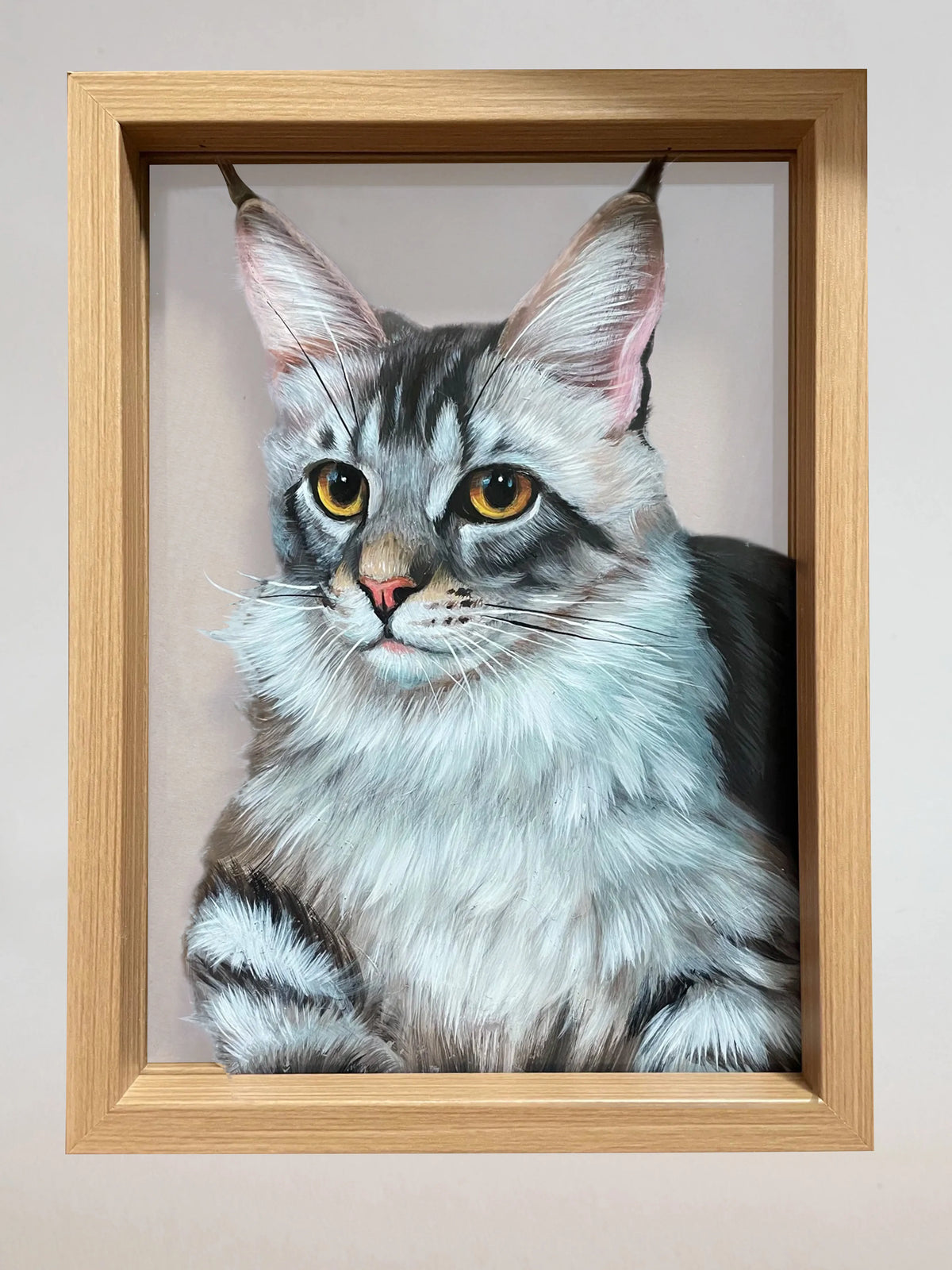
| Artwork painted on glass | Crisp, luminous, polished, dimensional | Entryways, offices, shelves, memorial displays | Clear detail, distinctive finish, strong visual depth | Reflection, weight, edge protection, breakage risk, included stand or hardware | PetDecorArt glass portrait details |
| Wood-framed flat portrait | Traditional, warm, easy to coordinate | Most rooms and gift situations | Ready to display, broad finish choices, works with both modern and traditional decor | Solid wood versus composite molding, backing, corner quality, included hardware | PetDecorArt framed portrait |
| 3D relief in a wooden frame | Lifelike, tactile, emotionally expressive | Memorial shelves, mantels, bedrooms, dedicated portrait walls | Captures fur direction and facial depth; more dimensional than a flat painting | Interior depth, exposed versus covered surface, dust protection, frame weight | PetDecorArt 3D wool portrait |
| True memory shadow box | Story-centered, layered, personal | Memorial walls and remembrance shelves | Can preserve a collar, tag, photo, paw print, toy, fur, or written memory together | Acid-free backing, attachment method, internal depth, removable mounting, glazing | Library of Congress framing guidance |
No option is automatically “best.” The right choice depends on whether you value wall impact, low glare, physical depth, easy gifting, or the ability to include real objects.
Which Framed Pet Portrait Should You Choose?
On a phone, swipe sideways to view all columns.
| Your priority | Best starting option | Why it fits | What to avoid |
|---|---|---|---|
| A large living-room focal point | Framed or float-framed canvas | Canvas carries visual weight without becoming excessively heavy | A tiny portrait floating alone above wide furniture |
| A polished gift that is ready to display | Finished wood-framed portrait | The recipient does not have to measure, shop for a frame, or install the artwork themselves | An unframed print in an uncommon size |
| Sharp facial detail and luminous color | Hand-painted glass portrait | The smooth surface supports crisp detail and a modern presentation | Placement directly opposite a bright window |
| A lifelike memorial with physical texture | 3D wool-felt portrait in a wooden frame | Fur direction, muzzle shape, ears, and expression can be represented in relief | Ordering from one blurry, filtered photograph |
| A portrait plus collar, tag, or paw print | True memory shadow box | The deeper interior provides room for both an image and three-dimensional belongings | Permanently gluing irreplaceable items without permission |
| A home with active children or pets | Lightweight canvas or acrylic-glazed framed print | Lower breakage risk than exposed glass when securely installed | Heavy glass artwork placed near the edge of a low shelf |
| A small desk, nightstand, or shelf | 4 × 6, 5 × 7, or 6 × 6 framed portrait | Compact sizes remain visible without overpowering nearby objects | A deep frame that blocks doors, lamps, or frequently used items |
Framed Canvas Pet Portraits
Canvas is a practical choice when you want the portrait to feel like wall art rather than a framed photograph. Its woven texture softens digital sharpness and can make fur, feathers, and painterly backgrounds feel warmer.
When canvas works best
- You want an 11 × 14-inch or larger statement piece.
- The portrait will hang where reflected window light would be distracting.
- You like visible brush texture or a painted appearance.
- You want a relatively lightweight piece for drywall installation.
- The room has a relaxed, modern, farmhouse, or transitional style.
Gallery wrap, standard frame, or float frame?
A gallery-wrapped canvas continues around the side edges and may be displayed without an outer frame. A standard frame covers the outer edge. A float frame leaves a narrow visible gap around the canvas, making it appear suspended inside the frame.
| Canvas finish | Appearance | Best for | Ask before ordering |
|---|---|---|---|
| Gallery wrap | Clean and frameless | Modern rooms and casual wall displays | Will important parts of the portrait wrap around the edge? |
| Standard frame | Traditional and finished | Gifts, offices, bedrooms, mixed gallery walls | How much of the canvas edge will the frame cover? |
| Float frame | Contemporary with visible separation | Statement portraits and premium presentation | What is the gap width, frame depth, and finished outside size? |
Traditional canvas paintings are often displayed without front glass so their surface texture remains visible. Ask the artist before adding glazing, particularly if the artwork has raised paint or a protective varnish.
Glass Pet Portraits
A glass pet portrait can mean one of two things: artwork painted directly on glass, or a paper artwork protected behind a glass sheet. These products should not be evaluated in the same way.
Artwork painted directly on glass
With this format, glass is part of the artwork itself. PetDecorArt describes its glass portraits as hand-painted, photo-based pieces with dimensional depth. The smooth surface gives the image a crisp, luminous quality that differs from textured canvas.
This format is well suited to a shelf, office, entryway, bedside table, or small memorial display. Before ordering, confirm whether the frame, stand, backing, and hanging hardware shown in the product images are included.
A framed print protected behind glass
In a conventional frame, glazing protects a print or work on paper from handling and dust. The artwork should not sit directly against the glazing. A mat or internal spacer helps maintain separation.
The Library of Congress notes that acrylic glazing is lighter and less brittle than glass and may filter ultraviolet light, although it scratches more easily and may bow at larger sizes. See its paper preservation FAQ.
When glass may not be the easiest choice
- The portrait will hang directly across from a bright window.
- The frame will be frequently moved between homes or events.
- The artwork will sit on a low shelf accessible to children or active pets.
- You need a very large piece but have limited wall support.
- You prefer a soft, low-reflection surface.
Wood-Framed Pet Portraits
“Wood portrait” can describe artwork printed on wood, but in most custom pet portrait listings it refers to the outer frame. Always check which meaning the seller intends.
Wood frames are popular because they can look formal, rustic, minimal, or memorial-focused depending on the profile and finish. They also pair naturally with warm fur colors and home furnishings.
Choosing a wood finish
| Frame finish | Works well with | Watch for |
|---|---|---|
| Natural oak or light wood | White walls, Scandinavian rooms, light-colored cats and dogs | Pale portraits may need a darker mat or background for separation |
| Walnut or dark brown | Warm interiors, traditional rooms, memorial shelves | A very dark frame can overpower a small portrait |
| Black | Modern rooms, black-and-white pets, gallery walls | Glossy black surfaces may show dust and fingerprints |
| White | Colorful portraits, nurseries, light and casual rooms | White fur may blend into both the background and frame |
| Gold or decorative molding | Formal gifts, traditional oil-painting styles, tribute displays | Highly ornate molding can distract from a small pet face |
Solid wood versus composite molding
Solid wood may have natural grain variation and can often be repaired or refinished. Composite molding can provide a consistent appearance at a lower cost. Neither material is automatically superior for every portrait.
More useful questions include whether the corners are securely joined, whether the backing is rigid, whether the hanging hardware suits the finished weight, and whether the frame depth matches the artwork.
Shadow Box Pet Portraits
A shadow box is a deep frame designed to hold objects with real thickness. It can be used in two different ways for a pet portrait.
1. A three-dimensional pet portrait in relief
A wool-felt head or half-body portrait can project outward from the backing, creating a shadow-box-like appearance. This format emphasizes the pet’s muzzle, ears, eye placement, coat direction, and expression.
PetDecorArt’s framed wool portrait is a dimensional relief in a wooden frame. It should not be confused with a traditional memorabilia shadow box intended to hold several removable belongings.
2. A memory shadow box with personal objects
A true memorial shadow box may combine a portrait with a collar, identification tag, paw-print impression, favorite bandana, small toy, lock of fur, whiskers, nameplate, or written memory.
- Can the object be removed later without damage?
- Is it sewn, tied, clipped, pinned, or permanently glued?
- Does the backing use archival or acid-free material?
- Is there enough clearance so fur, fabric, or photographs do not press against the glazing?
- Can the back be opened without destroying the frame?
- Will the seller return unused fur, whiskers, tags, or fabric?
Do not take a pet’s collar, fur, whiskers, ashes, or other emotionally important belongings for a surprise commission unless the owner has clearly agreed.
For more guidance on choosing a remembrance format, read Best Custom Pet Memorial Gifts.
Recommended PetDecorArt Framed Pet Portrait Options
PetDecorArt’s currently documented framed options focus on hand-painted glass artwork and three-dimensional wool portraits in wooden frames. Product prices and specifications below were checked on July 24, 2026. Handmade options, production queues, available sizes, and prices can change, so review the linked product page before ordering.
Custom Hand-Painted Pet Portrait With Frame
This option is intended for shoppers who want a finished portrait rather than artwork that still needs to be framed. PetDecorArt’s product highlights describe it as hand-painted on glass, supplied with a frame, and customizable by size, pose, and number of pets.
Best for: Birthdays, anniversaries, housewarming gifts, memorial shelves, bedrooms, hallways, and offices.
Before ordering: Confirm the selected frame finish, outside dimensions, display hardware, and whether the portrait orientation matches the available space.
View the Framed Pet Portrait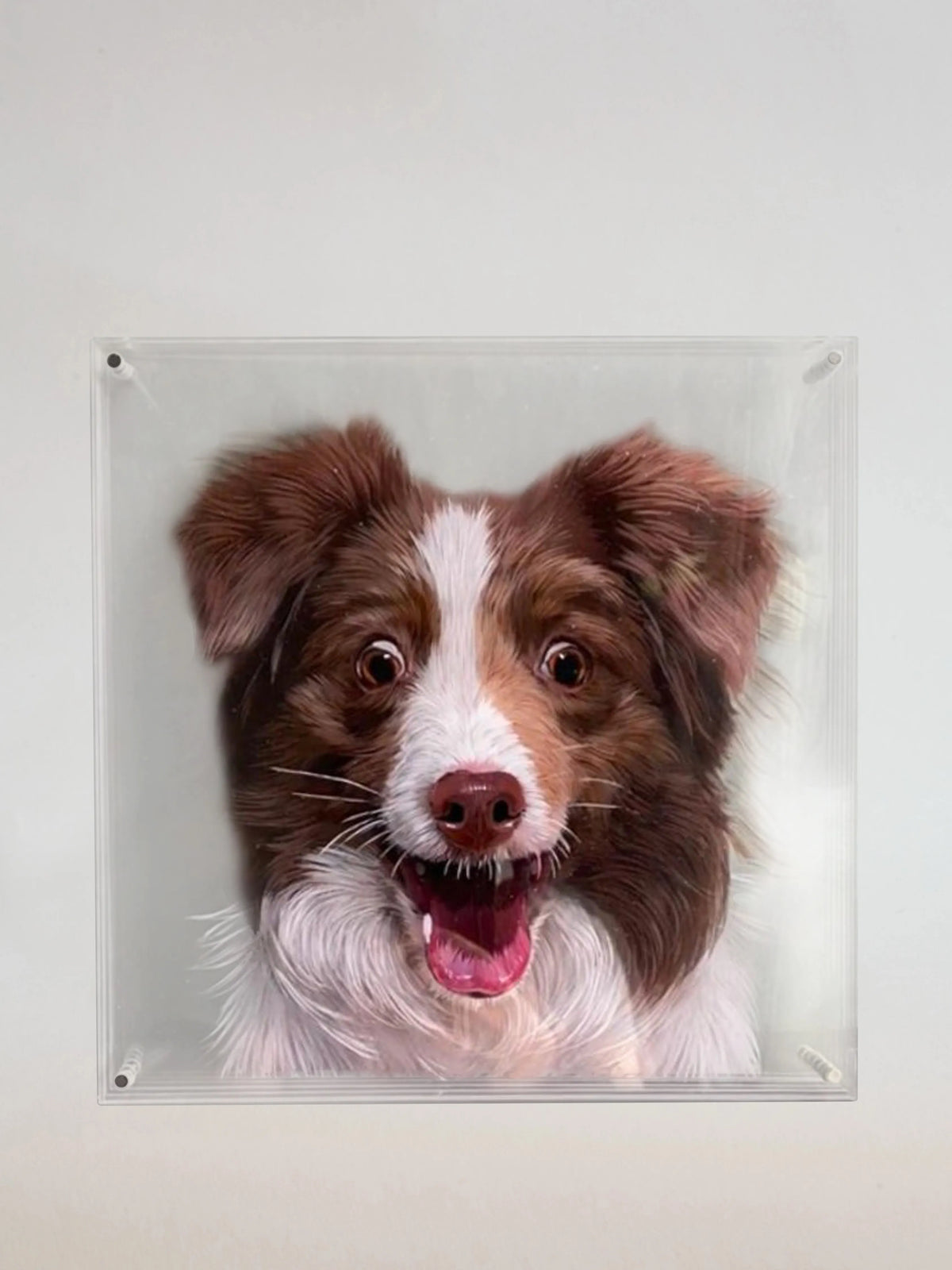
Custom Pet Oil Painting From Photo on Glass
This glass-first option is designed for shoppers who prefer clear detail and dimensional depth over the texture of traditional canvas. PetDecorArt states that the portrait is hand-painted from a customer photograph and can be customized with multiple pets or a full-body composition.
Best for: Modern interiors, polished memorial pieces, shelves, desks, entryways, and smaller wall areas.
Before ordering: Confirm whether the selected configuration includes a frame, tabletop support, wall hardware, or another display method. Avoid positioning it directly opposite a bright window.
View the Glass Pet Portrait
3D Custom Stuffed Animal Clone With Wooden Frame
This is a dimensional wool-felt relief rather than a flat print. The pet’s head or upper body projects from the backing, creating greater physical depth and a stronger sense of presence.
Best for: A lifelike memorial, senior-pet tribute, milestone gift, mantel display, or dedicated remembrance area.
Before ordering: Provide clear front, side, and close-up photographs. Obtain permission before sending real fur or whiskers, and ask how any unused material will be returned.
View the 3D Wooden-Frame PortraitYou can also browse the full PetDecorArt pet portrait collection or compare its hand-painted portrait options.
How to Choose the Right Framed Pet Portrait Size
Portrait size should be based on the completed outside dimensions, not only the artwork opening. A wide molding or deep shadow frame can make the finished piece noticeably larger than the listed image size.
| Approximate portrait size | Good location | Typical visual effect | Best composition |
|---|---|---|---|
| 4 × 6 or 5 × 7 inches | Desk, nightstand, small shelf | Personal and compact | One pet, head-and-shoulders crop |
| 6 × 6 or 7 × 7 inches | Square shelf, small gallery wall | Balanced and modern | Centered face or close-up |
| 6 × 8 or 8 × 10 inches | Office, hallway, bedside wall | Visible without dominating the room | One pet or a carefully arranged pair |
| 8 × 12 inches | Small focal wall, console, memorial display | More formal and prominent | Full head, chest, or horizontal two-pet composition |
| 10 to 16-inch deep frame | Mantel, larger shelf, dedicated display wall | Strong three-dimensional presence | Wool-felt head or half-body relief |
| 11 × 14 inches and larger | Living room or statement wall | Room-anchoring artwork | High-resolution photograph with space around the pet |
A practical wall-width rule
For a portrait hanging alone above a console, bench, or other piece of furniture, start by testing an artwork width equal to roughly one-half to three-quarters of the furniture width. This is a visual starting point, not a strict rule.
Before ordering, cut kraft paper or newspaper to the expected outside frame dimensions and tape it temporarily to the wall. View it from the doorway, sofa, and normal walking path. This simple test reveals sizing problems more reliably than judging a product mockup on a phone.
Remember frame depth
A deep shadow box may fit the wall width but still interfere with a door, cabinet, lamp, or narrow hallway. Request the complete outside width, height, depth, and finished weight.
How to Choose the Right Photo for a Framed Pet Portrait
A premium frame cannot correct a reference photo that hides the pet’s defining features. The strongest portrait begins with recognizable eyes, ear shape, muzzle proportions, markings, and natural coat color.
- The eyes are sharp and not hidden by motion blur or glare.
- Both ears are visible unless the crop is intentional.
- The photograph shows a familiar expression.
- The coat color is not altered by a filter or colored indoor light.
- Distinctive spots, scars, gray areas, and facial markings are visible.
- The image is the original file rather than a social-media screenshot.
- The pet occupies a meaningful part of the image.
- The face is not distorted by an extreme wide-angle close-up.
For a flat canvas or glass portrait
One excellent front-facing photograph may be enough, but two or three references can help confirm coat color, eye color, and markings.
For a 3D wool-felt portrait
Supply a front view, both side views when available, and close-ups of the eyes, nose, ears, and coat texture. For a half-body portrait, include photographs showing chest markings and the way the fur falls around the neck.
When your only photographs are old or blurry
- Collect several imperfect images rather than relying on one enlarged screenshot.
- Check old phones, cloud albums, family messages, videos, veterinary records, groomer photos, and pet-sitter accounts.
- Tell the artist which feature to take from each image.
- Do not ask the artist to guess eye color, markings, or ear shape without labeling the uncertainty.
- Request a confirmation image or proof when the ordering process allows it.
For dog-specific photo and likeness guidance, read How to Choose a Realistic Custom Dog Portrait. Cat owners can also use PetDecorArt’s cat art and home decor guide.
Choose the Frame for the Room Where It Will Live
A portrait can be beautifully made and still feel wrong if its finish, depth, or reflection does not suit the room.
| Room or location | Good portrait format | Recommended frame direction | Main concern |
|---|---|---|---|
| Living room | Large canvas or finished framed portrait | Coordinate with major furniture rather than every small accessory | Choosing a portrait that is too small for the wall |
| Bedroom | Canvas, framed glass, or small wood portrait | Soft natural wood, white, walnut, or another quiet finish | Highly reflective glazing facing the bed or window |
| Home office | 5 × 7, 6 × 8, or 8 × 10 framed portrait | Simple profile that does not compete with screens and shelves | Reflections from task lighting |
| Hallway | Shallow frame or canvas | Secure, low-profile installation | A deep shadow box projecting into a narrow walking path |
| Memorial shelf | Glass portrait or 3D wool portrait | Wood finish that relates to the urn, collar, or nearby objects | Overcrowding the display with too many unrelated items |
| Child’s room | Lightweight canvas or acrylic-glazed print | Secure hardware and rounded or simple edges | Heavy glass positioned above a bed or play area |
| Bathroom | Usually choose another location | Only use materials approved for humid conditions | Steam, condensation, swelling, mold, and finish damage |
| Sunny entryway | UV-filtering framed print or carefully placed canvas | Position away from direct rays | Fading, heat, and strong glare |
For a personalized portrait to feel integrated rather than added as an afterthought, repeat one or two colors from the artwork elsewhere in the room. A blanket, planter, book spine, or small accessory is usually enough.
Questions to Ask Before Ordering a Custom Pet Portrait With a Frame
On a phone, swipe sideways to view all columns.
| Question | Why it matters | What a useful answer should include |
|---|---|---|
| What is the artwork actually made from? | “Oil portrait” does not always identify the substrate | Canvas, paper, glass, acrylic panel, wood panel, wool, or another named material |
| Is the frame included in the listed price? | Product photos may show optional styling | Exact included frame, finish, dimensions, and hardware |
| Is the clear surface part of the artwork or protective glazing? | This changes cleaning, reframing, and breakage considerations | Painted glass, removable glass glazing, or acrylic glazing |
| What are the finished outside dimensions? | Listed artwork size may exclude the frame | Overall width, height, and depth |
| How much does the finished piece weigh? | Hanging hardware must suit the complete weight | Approximate packaged and unpackaged weight |
| Can I review a proof or completion photo? | Personalized items may be difficult to return | When approval occurs and what can still be changed |
| How are revisions handled? | “Unlimited revisions” may have conditions | Number, timing, scope, and whether structural changes cost extra |
| Can more than one pet be included? | Multiple pets require more space and may affect price | Maximum number, layout method, and additional cost |
| What is the realistic creation and delivery window? | Handmade production and transit are separate | Proof time, creation time, shipping time, and holiday cutoff |
| What happens if the frame or glass arrives damaged? | Personalized art can be difficult to replace quickly | Photo deadline, packaging requirements, remake process, and responsible party |
| How should the finished artwork be cleaned? | The wrong cleaner may damage paint, coatings, or acrylic | Material-specific written care instructions |
| What happens to uploaded photos and mailed keepsakes? | Photos, fur, whiskers, and collars may be irreplaceable | Storage, use, return, deletion, and leftover-material policy |
Budget for the complete order
The starting price may not include an additional pet, larger frame, full-body composition, rush production, premium shipping, taxes, or special materials. Compare the final checkout price rather than the smallest advertised configuration.
For a broader comparison of handmade, digital, painted, and three-dimensional formats, see Best Custom Pet Portraits in 2026.
How to Care for a Framed Pet Portrait
Keep it away from direct sunlight
Ultraviolet filtering can reduce exposure, but it does not make artwork immune to fading. The National Park Service recommends UV-filtering glass or acrylic for framed documents and works of art. See its museum environment guidance.
The simplest home precaution is to avoid hanging the portrait where direct sunlight crosses it for several hours each day.
Avoid rapid temperature and humidity changes
Do not hang a valuable portrait directly above a heating vent, radiator, fireplace, humidifier, or frequently used shower. Wood, paper, canvas, adhesives, and backing boards can all respond differently to changing conditions.
Do not spray cleaner directly on the frame
Liquid can run around the edge of the glazing and reach the artwork or backing. Apply a suitable cleaner to a cloth only when the maker’s instructions allow it.
Clean each material differently
| Material | Safer routine | Avoid |
|---|---|---|
| Canvas | Use a soft, dry dusting tool and follow the artist’s care instructions | Water, household sprays, scrubbing, and pressing on the canvas |
| Glass glazing | Clean carefully with a soft cloth and keep moisture away from frame edges | Spraying cleaner directly onto the assembled frame |
| Acrylic glazing | Use an acrylic-safe cloth and approved cleaner | Paper towels, abrasive cleaners, and ammonia-based products |
| Painted glass artwork | Follow the artist’s instructions for the painted and unpainted surfaces | Assuming it can be cleaned like an ordinary window |
| Wood frame | Dust with a soft dry cloth | Furniture polish unless the maker specifically recommends it |
| Wool-felt relief | Keep covered or dust gently without pulling fibers | Vacuum suction, water, rubbing, and frequent handling |
Use secure hanging hardware
Hang heavy glass and deep shadow frames from structural hardware suited to the wall and total weight. Do not rely on a small adhesive hook simply because the visible artwork is compact.
What to Inspect When the Portrait Arrives
Photograph the unopened package if it is crushed, punctured, wet, or visibly damaged. Open it carefully and retain the packaging until the portrait has been fully inspected.
- The pet’s name, markings, eye color, ear shape, and requested expression.
- The selected size, orientation, frame color, and portrait format.
- Glass or acrylic for chips, cracks, scratches, cloudiness, or pressure marks.
- Frame corners for gaps, dents, loose joints, or finish damage.
- The artwork for shifting, wrinkles, contact with glazing, or uneven spacing.
- The backing for looseness, punctures, or missing fasteners.
- Hanging hardware or tabletop support for secure attachment.
- Any real fur, whiskers, collar, tag, or other supplied material.
Report damage within the seller’s stated deadline and include photographs of the shipping carton, protective materials, label, full product, and close-up damage. Do not discard the packaging until the seller confirms the next step.
Frequently Asked Questions
Is canvas or framed glass better for a custom pet portrait?
Canvas is better when you want a soft, textured, low-glare wall piece, especially in a larger size. Framed glass artwork is better when you want crisp detail, luminous color, and a polished display for a shelf, office, hallway, or smaller wall.
Does a canvas pet portrait need glass?
Traditional stretched canvas is commonly displayed without front glass so its surface remains visible. Ask the artist before adding glazing because raised paint, varnish, stretcher depth, and frame design may affect the recommendation.
What is the difference between a glass portrait and a portrait behind glass?
A glass portrait is painted or created directly on a glass surface. A portrait behind glass is usually printed or painted on paper and protected by a separate removable glazing layer.
Is a wood frame better than a metal frame?
Wood provides warmth and a broad range of decorative finishes. Metal usually creates a slimmer, more modern profile. Construction quality, depth, weight capacity, and compatibility with the artwork matter more than the material name alone.
Is a 3D wool portrait the same as a shadow box?
Not necessarily. A framed wool-felt relief has shadow-box-like depth, but a true memory shadow box is designed to hold multiple objects such as a collar, tag, photograph, or paw-print impression.
What size framed pet portrait should I buy?
Choose 4 × 6 or 5 × 7 inches for a desk or shelf, 6 × 8 or 8 × 10 inches for a small wall, and a larger canvas for a living-room focal point. Always check the completed outside frame dimensions.
Can a framed portrait include more than one pet?
Many custom artists accept multiple pets, but the image needs enough space to preserve each face. Ask how the pets will be scaled, whether separate photos can be combined, and whether an additional-pet fee applies.
What is the best photo for a framed pet portrait?
Use an original, well-lit photograph with sharp eyes, visible ears, accurate coat color, and a familiar expression. For three-dimensional portraits, include front, side, and detail photographs.
Can an artist make a portrait from an old or blurry photo?
Sometimes, but do not expect missing details to be reconstructed accurately from one small image. Send several photographs and explain which image best shows the eyes, markings, ear shape, coat color, and expression.
Can real pet fur or whiskers be added to a framed portrait?
Some wool-felt artists can incorporate real fur or whiskers. PetDecorArt lists this possibility for its framed wool portrait. Ask how the material will be handled, attached, stored, and returned before mailing anything irreplaceable.
What frame color is safest for a gift?
Natural wood, walnut, black, and white are the most versatile choices. When possible, look at the recipient’s furniture, existing picture frames, and wall color rather than choosing based only on the pet’s coat.
Can I hang a framed pet portrait in a bathroom?
A bathroom is usually not the best location because steam and changing humidity can affect wood, backing boards, canvas, paper, adhesives, and felt. Choose a bedroom, hallway, office, or living area instead.
How long does a custom framed pet portrait take?
Digital portraits may be completed quickly, while hand-painted and wool-felt work often requires several weeks. Add proofing, revisions, shipping, and possible holiday delays when planning a gift date.
Should a pet memorial portrait be a surprise?
A modest framed portrait can be an appropriate surprise for someone you know well. Lifelike replicas, large memorial pieces, shadow boxes, urns, and artwork using fur, whiskers, ashes, or collars should usually be discussed first.
Related PetDecorArt Guides
Turn a Favorite Pet Photo Into a Framed Keepsake
Start by deciding where the portrait will be displayed, how much physical depth you want, and whether the piece should feel like everyday home decor or a dedicated memorial. Then choose the size and medium before selecting the frame finish.
View Custom Pet Portrait Options Compare Hand-Painted Glass Portraits Read the Complete Portrait Selection Guide


