
A custom pet sweatshirt can feature the same dog or cat photo and still look completely different depending on how the portrait is applied. Embroidery turns the image into layered threadwork with visible texture. Printing keeps the design flat and can preserve more colors, shadows and photographic detail.
The better option is not determined by price alone. Portrait size, garment fabric, photo quality, comfort, washing habits and the number of pets in the design all affect which method will produce the better result.
Quick Answer
Choose custom pet embroidery when you want a small, textured portrait that feels personal, premium and appropriate for everyday sweatshirts, hoodies, T-shirts, polos or caps.
Choose printed pet clothing when you want a large photograph, several pets, an all-over pattern, a detailed background or artwork with many gradients and colors.
Best for a large full-color pet photograph: printing.
Best for a sentimental wearable gift: usually embroidery.
Best for multiple pets or a complex scene: usually printing.
Custom Pet Embroidery vs. Printed Pet Clothing at a Glance
Swipe or drag the table horizontally on a phone.| Decision factor | Custom pet embroidery | Printed pet clothing | Better choice |
|---|---|---|---|
| Finished appearance | Raised, textured and handmade-looking | Flat, smooth, graphic or photographic | Depends on your preferred style |
| Small left-chest portrait | Looks deliberate and premium | Can look less substantial when printed very small | Embroidery |
| Large front design | Can become heavy, stiff and expensive | Can cover a much larger area more comfortably | Printing |
| Photographic detail | Simplifies the photo into stitchable shapes and thread colors | Can preserve more gradients, shadows and small markings | Printing |
| Texture and depth | Visible thread direction creates physical depth | Usually flat or slightly raised depending on the process | Embroidery |
| Several pets | Each face may become too small when placed in one compact portrait | Provides more space for several pets and names | Printing |
| Large color range | Limited to a carefully selected thread palette | Better for complex gradients and multicolored backgrounds | Printing |
| Sentimental gift | Often feels like a wearable keepsake | Better when the original photograph itself is important | Embroidery for a subtle keepsake |
| All-over pattern | Not practical across an entire garment | Can cover the front, back and sleeves | Printing |
| Lightweight T-shirt | Works best as a small portrait on sufficiently stable fabric | Better suited to a large design on lightweight fabric | Depends on design size |
| Cap or structured accessory | Compact stitching works naturally on structured fabric | Printing may struggle on curved or textured areas | Embroidery |
| Production approach | Photo interpretation, stitch planning and hand or machine stitching | Digital artwork prepared for DTG, DTF, sublimation, screen printing or another process | Different methods for different designs |
The most important distinction: embroidery and printing are not simply two ways to apply the same image. Embroidery interprets the pet through thread, while printing can reproduce a larger portion of the original photograph.
How Each Method Turns a Pet Photo Into Clothing
How custom pet embroidery works
A pet photograph cannot be copied directly into thread in the same way it can be placed into a digital print. The face must first be interpreted as stitchable areas. The artist decides which markings are essential, where the fur changes direction and how much contrast is needed around the eyes, nose, mouth and ears.
The strongest embroidered portraits do not attempt to reproduce every strand of fur. They preserve the features that make the animal recognizable: an uneven ear, white eyebrow, dark muzzle, pink nose, crooked smile or distinctive patch around one eye.
Thread also reflects light differently depending on stitch direction. This can make short fur, long fur and facial contours appear more dimensional, even though the portrait contains fewer color transitions than a printed photograph.
How printed pet clothing works
Printed pet clothing begins with a digital file. The background may be removed, the pet may be isolated and the colors may be corrected before the artwork is transferred to the garment.
Printing is better able to retain subtle shadows, colored lighting, small coat variations and complex decorative elements. This makes it useful for full-body photographs, several pets, memorial quotes, flowers, landscapes and repeating patterns.
The final result depends heavily on the exact printing process. Direct-to-garment printing, direct-to-film transfers and sublimation do not feel or wear in the same way, even when the product page describes all three as custom printed clothing.
Which Method Looks More Like Your Pet?
Printing normally reproduces more of the photograph. Embroidery often creates a more selective but physically expressive interpretation.
A good print can preserve tiny changes in coat color, reflections in the eyes and soft fur along the outer edge. This is valuable for pets with merle, brindle, tortoiseshell or multicolored coats.
Embroidery relies more heavily on the artist’s judgment. At a small size, the portrait needs enough simplification to remain clean while preserving the pet’s identity.
Embroidery is more likely to look successful when:
- The pet’s face is clearly visible.
- The eyes, nose and ears are in focus.
- The pet has recognizable facial markings.
- The portrait will be approximately 2 to 3.5 inches wide.
- You prefer a crafted interpretation rather than a literal photo copy.
Printing is more likely to look successful when:
- You want to preserve the original photograph closely.
- The design includes several pets or people.
- The background is an important part of the memory.
- The artwork includes a long quote, flowers or decorative framing.
- The image needs to cover a large part of the garment.
Try this before ordering: reduce the pet photo on your phone until the face is approximately the same size as the planned portrait. If the pet remains easy to recognize, a small embroidered design should work well. If the important markings disappear, use a larger portrait or choose printing.
The Portrait Detail Budget: What Most Buyers Overlook
Every custom pet portrait has a limited amount of usable visual space. That space can be thought of as a detail budget.
A 2-inch portrait has room for the pet’s most important facial features, but not every whisker, fur strand, collar tag and background object. A 3.5-inch portrait provides more room, but the design still needs to remain readable from a normal viewing distance.
Printed designs have a larger detail budget because they can use small pixels and subtle tonal changes. Embroidery uses physical thread, so each line and patch needs enough space to remain visible.
| Design element | 2-inch embroidery | 3.5-inch embroidery | Large printed design |
|---|---|---|---|
| Eyes, nose and mouth | Should remain the main priority | Can include more shading and expression | Can retain photographic detail |
| Ear shape | Usually possible when the ears are visible | More room for folded or uneven ears | Can retain the full outline |
| Long fur | Must be simplified | Can show more stitch direction | Can preserve wispy edges |
| Collar and tag | May need to be removed | Simple collar details may work | Usually easy to retain |
| Pet name | Best placed separately | Short names may fit near the portrait | Longer text and multiple lines are possible |
| Background | Usually removed | Usually removed or greatly simplified | Can remain part of the design |
| Several pets | Usually too crowded | Two simplified faces may work | Best option for a larger group |
A smaller design is not automatically lower quality. It simply needs stricter editing. A clean portrait that preserves five recognizable features will usually look better than one that attempts to squeeze twenty tiny details into the same area.
How Portrait Size and Placement Change the Answer
Small left-chest portrait
This is the strongest use case for embroidery. A compact portrait feels similar to a personalized emblem and remains easy to wear with everyday outfits.
A 2-inch portrait is best for shoppers who want a subtle design. A 3.5-inch portrait provides more room for facial markings, long fur and a fuller body composition.
Large center-chest portrait
Printing becomes more practical as the design grows. A large embroidered pet face requires more thread, more stabilization and more time. It can also make the center of a sweatshirt feel heavier and less flexible.
Full-back design
Printing is generally the better choice for a full-back portrait, long memorial quote, floral frame or scene containing several animals.
Sleeve, cuff or small accessory
Embroidery works well for a short pet name, paw print, date, tiny face or simple outline. Long text and highly detailed artwork are more suited to printing.
| Placement | Recommended method | Reason |
|---|---|---|
| 2-inch left chest | Embroidery | Compact, subtle and well suited to everyday clothing |
| 3.5-inch left chest | Embroidery | Provides more detail while keeping the portrait wearable |
| Large center chest | Printing | Allows a larger image without dense thread coverage |
| Full back | Printing | Better for large photos, quotes and decorative scenes |
| Cap front | Embroidery | Structured fabric supports compact stitching |
| Sleeve name | Embroidery | Short lettering looks clean in thread |
| All-over repeating pet faces | Printing | Full garment coverage is not practical with embroidery |
Comfort, Weight and Garment Feel
Comfort depends more on portrait size and garment construction than on the word embroidery or printing by itself.
A small embroidered portrait adds limited weight to a sweatshirt or hoodie. The stitched area may feel slightly firmer than the surrounding fabric, but it should not make a properly made garment uncomfortable.
Large embroidery is different. More thread requires more backing and stabilization, which can make the garment feel rigid in that area.
Printing can cover a larger area with less structural weight, but the surface feel varies. DTG ink can feel relatively integrated with cotton fabric, while a transfer-based print may feel smoother, thicker or more noticeable.
Choose embroidery for comfort when:
- The portrait is small.
- The garment is a mid-weight sweatshirt, hoodie or structured T-shirt.
- The portrait is placed away from high-flex areas.
- You do not want a large printed panel across the chest.
Choose printing for comfort when:
- You want a large design on a lightweight shirt.
- You want a flat image without raised thread.
- You want an all-over pattern.
- You are especially sensitive to embroidery backing inside a garment.
People with sensitive skin should ask how the back of the embroidered area is finished. The portrait may look smooth on the outside while exposed backing feels rough against bare skin.
Durability and Common Failure Points
Small, properly made embroidery is often a strong choice for clothing that will be worn repeatedly. The image is formed from thread rather than a large printed surface.
Embroidery is not damage-proof. Loose threads can snag, excessive stitch density can pull the fabric and aggressive washing can wear fine details.
Printed clothing can also remain attractive for a long time, but durability depends on the method, garment material, curing process and care routine. A sublimated polyester garment behaves differently from a surface-applied transfer.
| Potential issue | Embroidery | Printing | How to reduce the risk |
|---|---|---|---|
| Fading | Thread color can gradually change through washing, sunlight or harsh chemicals | Ink may fade depending on the print method and care | Wash cold, avoid bleach and dry with low heat |
| Cracking | Not a typical embroidery problem | Can occur with some surface-applied prints | Turn the garment inside out and avoid high heat |
| Peeling | Not a typical embroidery problem | Can occur when a transfer loses adhesion | Confirm the printing method and follow its care instructions |
| Snagging | Raised threads may catch on rough objects or hooks | Less common with a flat print | Wash with soft garments and keep rough fasteners away |
| Puckering | Can occur when dense stitching pulls thin fabric | Normally not caused by the image itself | Choose a suitable garment weight and properly stabilized embroidery |
| Surface abrasion | Thread can wear where a strap repeatedly rubs | Large prints can also wear beneath bags or seat belts | Consider normal friction when selecting placement |
| Stretch damage | Dense threadwork may restrict highly stretchy fabric | Some transfer prints may crack when repeatedly stretched | Avoid placing large designs over high-stretch areas |
The safest conclusion is not that every embroidered garment lasts longer than every printed garment. Small embroidery simply avoids several problems associated with large surface prints, while high-quality printing can perform very well when matched to the correct fabric.
The Major Printing Methods Used for Pet Clothing
Before buying printed pet clothing, look for the exact production method. The phrase custom printed shirt does not tell you enough about the fabric compatibility, surface feel or likely wear pattern.
| Printing method | How it works | Best pet designs | Main trade-off | Learn more |
|---|---|---|---|---|
| Direct-to-garment printing | Ink is printed directly onto the garment and then cured | Detailed photographs and colorful one-off designs on suitable cotton garments | Results depend on fabric, pretreatment and production quality | DTG printing guide |
| Direct-to-film printing | Artwork is printed onto film and transferred to the garment with heat and adhesive | Colorful pet artwork on cotton, polyester and blended fabrics | The printed area may feel more noticeable than DTG | DTG and DTF comparison |
| Sublimation | Heat transfers dye into suitable synthetic fibers | All-over pet patterns, pajamas, athletic clothing and full-coverage designs | Most commonly used with polyester-rich garments rather than dark cotton | Sublimation guide |
| Screen printing | Ink is pushed through prepared screens, usually one color layer at a time | Simple pet illustrations, silhouettes and limited-color artwork | Less practical for a single photographic portrait with many colors | DTG and screen printing comparison |
| Heat-transfer vinyl | Cut vinyl shapes are applied to the garment with heat | Pet names, paw prints and simple silhouettes | Not intended for complex photographic detail | Shirt printing methods |
A product page that clearly names the printing method, garment material, design dimensions and care instructions gives you more useful information than one that only promises a high-definition or permanent print.
Choose Embroidery or Printing Based on Your Pet Photo
| Photo characteristic | Better starting choice | Reason | What to request |
|---|---|---|---|
| Clear face with a simple background | Embroidery | The most recognizable features can be isolated easily | A clean head portrait with visible ears and eyes |
| Long or fluffy fur | Either method | Embroidery can suggest fur direction, while printing retains wispy edges | Ask how fine fur will be simplified or preserved |
| Merle, brindle or tortoiseshell coat | Printing for maximum color detail | The coat may contain more variations than a compact thread palette can show | Request careful color adjustment |
| Black pet with limited visible detail | Either method after photo correction | The original exposure matters more than the application method | Brighten shadow detail without turning black fur gray |
| White pet against a pale background | Either method after background removal | The outer shape may disappear without contrast | Choose a darker garment or add subtle outline shading |
| Two pets photographed together | Printing for a large composition | Both faces need enough space to remain recognizable | Use a wide layout rather than a tiny chest badge |
| Pet and owner together | Printing | Human faces and a larger composition require more tonal detail | Use a full-front or back design |
| Memorial portrait with a short name or date | Embroidery | A small portrait and restrained text create a subtle keepsake | Keep the wording short and separate from the face |
| Memorial quote with flowers and scenery | Printing | The composition contains too many elements for a small stitched area | Use a larger printable layout |
| Funny expression or action photo | Printing | The full photograph may be necessary to preserve the joke | Keep the original pose and surrounding context |
Photo requirements that improve either result
- Upload the original image rather than a screenshot.
- Use a photo taken in bright, even lighting.
- Make sure at least one eye is sharply focused.
- Avoid images in which a blanket, hand or toy covers the face.
- Do not use heavy filters that change the coat color.
- Include an additional reference photo when one ear or marking is hidden.
- Choose an image that shows the expression you associate with the pet.
Recommended PetDecorArt Custom Pet Embroidery
PetDecorArt’s wearable collection focuses on hand-embroidered pet portraits. The following options suit different seasons, garment preferences and gift budgets.
Prices and listed specifications were checked on July 10, 2026. Colors, sizes, stock status and delivery estimates may change, so review the current product page before ordering.

Custom Embroidered Personalized Sweatshirt With Pet Portrait
Listed price: $69.98
This crewneck sweatshirt is a practical starting point for buyers who want a personalized portrait without covering the entire front of the garment. Its mid-weight fabric and small left-chest placement are well matched to embroidery.
- Premium cotton-blend fabric
- Listed fabric weight: 300–350g
- 29 listed solid colors
- Relaxed unisex crewneck fit
- 2-inch or 3.5-inch portrait options
- Listed sizes: S–2XL
Best for: everyday wear, birthdays, pet parents who prefer crewnecks and subtle memorial gifts.
View the Custom Pet Sweatshirt
Custom Embroidered Pet Portrait Hoodie Long Sleeve
Listed price: $64.98
The long-sleeve hoodie is suited to cooler weather, casual layering and recipients who wear hoodies more often than crewneck sweatshirts. Its listed size range also extends farther than the crewneck and T-shirt options below.
- 100% cotton listed on the product page
- More than 8,000 listed stitches
- Eight listed garment colors
- Relaxed unisex fit
- 2-inch or 3.5-inch left-chest portrait options
- Listed sizes: S–5XL
- Approximate listed production time: 15–30 days
Best for: fall and winter gifts, broader sizing needs, travel and casual everyday wear.
View the Custom Pet Hoodie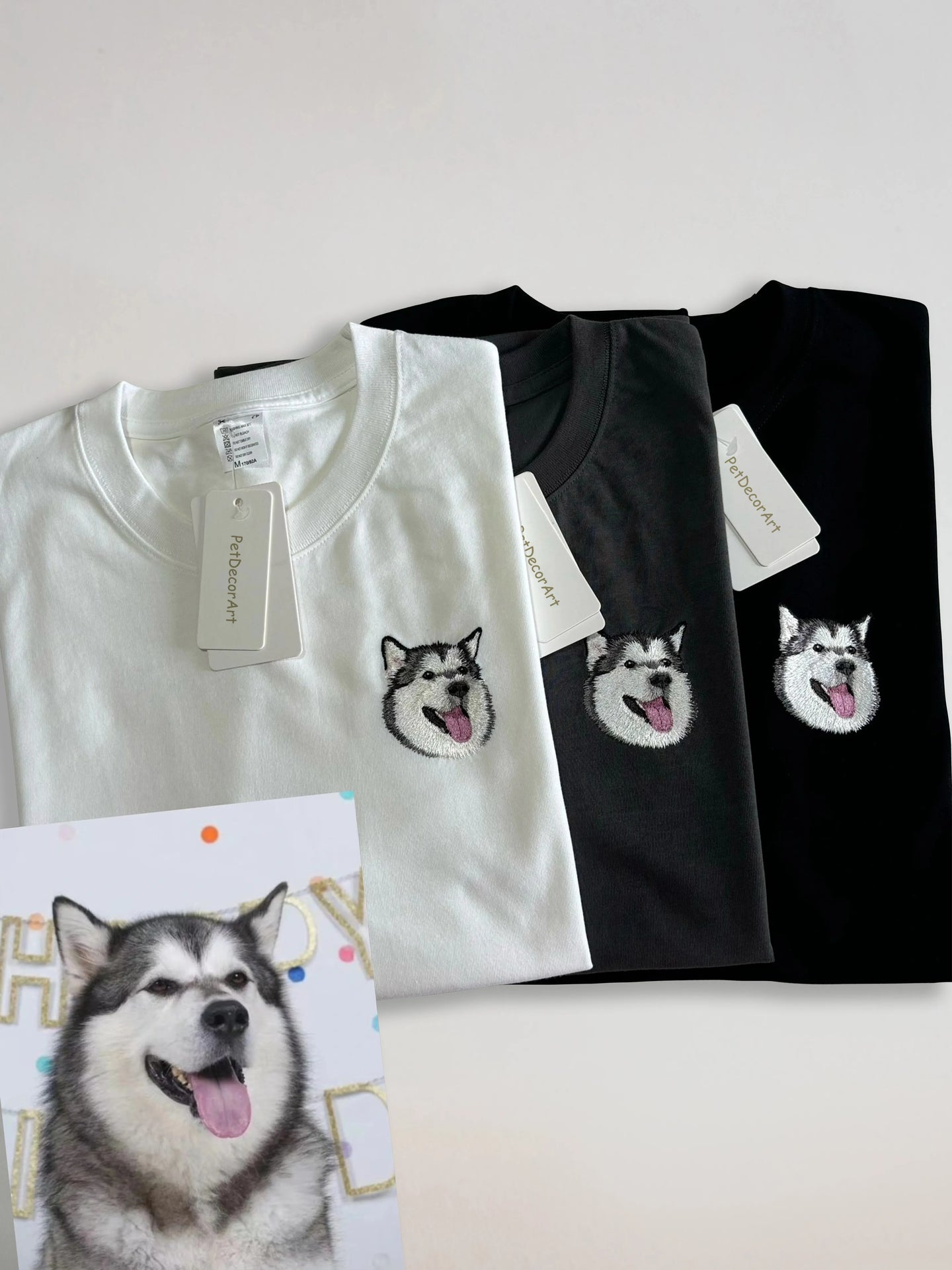
Custom Hand-Embroidered Pet Portrait T-Shirt
Listed price: $49.98
This T-shirt keeps the texture of embroidery while offering a lighter alternative to a sweatshirt or hoodie. The smaller portrait option is especially useful when you want the shirt to remain flexible and easy to layer.
- 100% cotton listed on the product page
- Eight listed garment colors
- 2-inch head portrait or 3.5-inch portrait option
- Listed sizes: S–3XL
- Optional hidden heart stitch for a memorial tribute
Best for: warmer climates, year-round layering, lower gift budgets and recipients who rarely wear sweatshirts.
View the Custom Pet T-ShirtPetDecorArt Product Comparison
Product details were checked on July 10, 2026. Review the live page for current options.| Product | Listed price | Material | Size range | Portrait options | Best for | Official product page |
|---|---|---|---|---|---|---|
| Personalized crewneck sweatshirt | $69.98 | Cotton blend, 300–350g | S–2XL | 2 inches or 3.5 inches | Everyday wear and easy gifting | View product |
| Long-sleeve embroidered hoodie | $64.98 | 100% cotton listed | S–5XL | 2 inches or 3.5 inches | Cold weather and broader sizing | View product |
| Hand-embroidered T-shirt | $49.98 | 100% cotton listed | S–3XL | 2 inches or 3.5 inches | Warm weather and lighter outfits | View product |
Best Method by Use Case
| What you are buying | Recommended method | Suggested format | Why |
|---|---|---|---|
| Everyday pet sweatshirt | Embroidery | 2-inch or 3.5-inch chest portrait | Personal without dominating the entire outfit |
| Pet memorial gift | Embroidery | Small portrait with a short name, date or hidden heart | Creates a restrained, wearable keepsake |
| Funny pet photo shirt | Printing | Large front photograph with a short caption | Preserves the original expression and context |
| Holiday family shirts | Printing | Matching full-color designs | More practical for several coordinated garments |
| Premium birthday gift | Embroidery | Mid-weight crewneck or hoodie | Thread texture gives the gift a crafted finish |
| Three or more pets | Printing | Large front, back or all-over composition | Each pet can remain large enough to recognize |
| Custom pet cap | Embroidery | Simplified head portrait | Structured caps naturally support compact stitching |
| Pet pajamas with repeating faces | Printing | All-over pattern | Repeating artwork can cover the entire garment |
| Minimalist pet clothing | Embroidery | Small portrait without extra text | Subtle from a distance and meaningful up close |
| Pet portrait with flowers and a long quote | Printing | Large front or back design | Provides enough room for all visual elements |
How to Judge Embroidery Quality Before Ordering
A high stitch count can indicate substantial work, but stitch count alone does not guarantee that the portrait will look like the pet. A carefully simplified design can look more recognizable than a dense portrait with poor proportions.
Look for these quality signals
- Accurate eye placement: slightly misplaced eyes can change the pet’s expression more than a missing patch of fur.
- Recognizable ear shape: folded, upright or uneven ears should not become a generic outline.
- Directional fur stitches: thread direction should support the visible coat pattern.
- Controlled dark areas: black fur still needs enough contrast for the eyes, nose and face shape to remain visible.
- Clean outer edges: the finished portrait should not contain obvious loops, gaps or loose thread tails.
- Appropriate stitch density: the surrounding garment should lie reasonably flat.
- Suitable fabric: the garment needs enough structure to support the selected portrait size.
- Real finished examples: look for photographs of completed clothing rather than only digital mockups.
Questions to ask before ordering embroidery
- Will the portrait include only the head or the full body?
- What are the exact finished dimensions?
- Is left chest based on the wearer’s left side?
- Can a second photograph be used to confirm hidden markings?
- How is the back of the embroidery finished?
- Can a pet name or memorial detail be added without crowding the portrait?
- Will the artist contact you if the uploaded image is unsuitable?
- When does production begin, and when can changes no longer be made?
How to Judge Printed Pet Clothing
Look for these print quality signals
- The product page identifies the printing method.
- The garment material is clearly listed.
- The seller shows close-up photographs of the printed surface.
- The finished design dimensions are provided.
- The mockup accurately represents how large the pet will appear.
- The seller explains how dark garments are printed.
- Care instructions cover washing, drying and ironing.
- Customer photos show actual garments rather than only computer-generated previews.
Be cautious when a seller promises that a print can never fade, crack or peel without identifying the production method. No customized garment is protected from every combination of heat, bleach, friction and repeated washing.
Ordering Checklist: Avoid the Most Common Mistakes
- Choose the application method first. Decide whether you want a small crafted portrait or a large photographic design.
- Select the final portrait size. Do not assume that every product photograph represents the exact scale you will receive.
- Confirm the placement. Left chest normally refers to the wearer’s left side.
- Upload the original photo. Avoid social media screenshots and compressed messaging-app copies.
- Match the garment color to the pet. The portrait needs enough contrast from the surrounding fabric.
- Use the product-specific size chart. Do not rely only on terms such as unisex, relaxed or true to size.
- Separate production time from shipping time. Handmade work may require several weeks before the parcel enters transit.
- Review the personalized-order policy. Custom products may have different cancellation and return conditions from standard clothing.
- Save your customization details. Keep a copy of the selected portrait size, placement, garment color, text and uploaded photo.
- Order early for important dates. Leave extra time before birthdays, anniversaries, Christmas or memorial events.
PetDecorArt’s long-sleeve embroidered hoodie product page currently lists an approximate production period of 15–30 days. Shipping and order confirmation require additional time.
How to Wash Embroidered and Printed Pet Clothing
Always follow the care label supplied with the finished garment. When machine washing is permitted, the following routine is a cautious starting point.
For embroidered pet clothing
- Turn the garment inside out.
- Use cold water and a gentle cycle.
- Use a mild detergent without bleach.
- Wash with soft garments rather than clothing with hooks or rough hardware.
- Hang dry or tumble dry on low when permitted.
- Do not place a hot iron directly on the embroidered portrait.
- Do not pull a loose thread.
- Avoid rubbing the portrait with a stiff stain-removal brush.
For printed pet clothing
- Confirm whether the garment uses DTG, DTF, sublimation or another process.
- Turn the garment inside out before washing.
- Use cold water unless the care label states otherwise.
- Avoid bleach and harsh spot treatment on the image.
- Use low dryer heat or air drying.
- Do not iron directly over the printed design.
- Avoid dry cleaning unless the product instructions allow it.
Turning a customized garment inside out reduces direct friction between the portrait and other items in the washing machine. This is useful for both embroidery and printing.
Final Verdict: Embroidery or Printing?
For a sweatshirt, hoodie, T-shirt or cap with a small pet portrait, embroidery is usually the better option. It gives the design physical texture, works naturally at left-chest scale and makes the garment feel more like a personalized keepsake.
For a large photograph, multi-pet design, all-over pattern or complicated composition, printing is usually the more suitable option. It provides more visual space and can retain a wider range of colors, shadows and background details.
Choose embroidery when the pet is the detail.
Choose printing when the entire photograph or scene is the design.
Buyers who want a subtle everyday garment should start with a 2-inch embroidered portrait. Buyers who want more visible facial detail can move up to approximately 3.5 inches. When the artwork needs to fill most of the shirt, printing becomes the more natural medium.
Related PetDecorArt Guides
Frequently Asked Questions
Is embroidery better than printing for custom pet clothing?
Embroidery is generally better for small chest portraits, premium gifts and textured everyday clothing. Printing is generally better for large photographs, detailed backgrounds, several pets and all-over patterns. Neither method is better for every design.
Which method looks most like the original pet photo?
High-quality printing can usually preserve more gradients, shadows and small color changes from the original photograph. Embroidery interprets the image using thread and simplified shapes, creating a more textured but less literal result.
Does embroidered pet clothing last longer than printed clothing?
Small, properly made embroidery can be highly durable, but the final lifespan depends on stitching quality, fabric and care. Printed durability varies between DTG, DTF, sublimation, screen printing and transfer methods.
Can printed pet clothing crack or peel?
Some surface-applied prints can crack or peel after repeated stretching, high dryer heat or rough washing. DTG and sublimation behave differently from thicker transfer prints, so check the exact printing method before buying.
Is an embroidered pet portrait uncomfortable?
A small chest portrait should not make a sweatshirt or hoodie excessively heavy. Discomfort is more likely when the embroidery is very large, overly dense, placed on thin fabric or finished with rough backing.
Should I choose a 2-inch or 3.5-inch embroidered portrait?
Choose 2 inches for a subtle, minimalist look. Choose 3.5 inches when the pet has important markings, long fur or features that need more space to remain recognizable.
What garment color is best for a black pet?
Light gray, cream, beige, pale blue and other lighter colors usually provide strong contrast. A black garment can still work when the portrait contains enough gray, brown or white highlighting around the eyes and outer face.
What garment color is best for a white pet?
Medium and dark colors help a white pet remain visible. Blue, green, burgundy, gray and black can provide useful contrast. On a pale garment, the portrait may need natural gray, beige or brown shading around the outer edge.
Can two pets be embroidered on one sweatshirt?
Two pets may be possible when the portrait is large enough, but both faces need adequate space. Placing two detailed faces inside a 2-inch area is likely to reduce recognition. A wider embroidered layout or large printed design may work better.
Is embroidery or printing better for a pet memorial gift?
Embroidery is often better for a quiet memorial gift because a small portrait feels personal and wearable. Printing may be preferable when the recipient wants the original photograph, a long quote, dates, flowers or a full memorial scene.
What type of photo is best for pet embroidery?
Use a clear original photo taken in good light. The face should be in focus, the eyes should be visible and the ears should not be cropped out. Avoid screenshots, heavy filters and images with objects covering important markings.
Can embroidered pet clothing be machine washed?
Many embroidered garments can be machine washed, but the supplied care label should always take priority. A cautious routine is to turn the garment inside out, wash it cold on a gentle cycle and use low dryer heat or hang drying.
How early should I order custom embroidered pet clothing?
Order several weeks before the garment is needed. PetDecorArt’s current embroidered hoodie page lists an approximate production period of 15–30 days, and confirmation and shipping require additional time.
Is printed pet clothing usually cheaper than embroidery?
Printing is often more economical for large designs or several matching garments. Embroidery requires stitch planning, threadwork and stabilization, particularly for detailed one-off portraits. The final price also depends on garment quality and customization.
Turn Your Favorite Pet Photo Into Wearable Art
Start with a clear photograph, choose a portrait size that suits the garment and select clothing you will genuinely wear. For most everyday sweatshirts, hoodies and T-shirts, a small embroidered chest portrait offers the best balance of personality, detail and wearability.
View Custom Embroidered Pet Clothing Create a Custom Pet Sweatshirt Read the Pet Photo Selection Guide


