
Custom Dog Art Guide
Last updated: June 15, 2026
Quick Answer
Yes. An artist can make a custom sculpture of your dog from photos, even if your dog cannot sit for an in-person session or has already passed away. Depending on the look, size, budget, and display location you want, the sculpture may be made from needle-felted wool, clay, resin, a 3D-printed material, carved wood, or cast bronze.
For most pet parents, a small full-body wool sculpture or framed 3D wool portrait offers the best balance of recognizable detail, warmth, and indoor display practicality. The most important step is not choosing the largest size. It is giving the artist clear photos that show your dog’s face, body proportions, markings, coat texture, and typical expression.
A custom dog sculpture is different from buying a mass-produced statue of a Labrador, French Bulldog, or Golden Retriever. A breed statue may resemble the general type of dog you own, but a true custom sculpture is built around the details that make your dog recognizable: the angle of the ears, the length of the muzzle, the shape of the chest, a white patch on one paw, an uneven smile, or the way the dog sits with one leg slightly turned outward.
That difference matters. Most owners are not looking for “a sculpture of a dog.” They are looking for a sculpture that makes a family member say, “That is absolutely Max.”
What Kinds of Dog Sculptures Can Be Made?
The word “sculpture” covers several types of custom pet art. Some pieces are soft and fur-like. Others are hard, smooth, miniature, life-size, realistic, or intentionally stylized.
| Sculpture type | Best for | Typical appearance | Main advantage | Main limitation | Example source |
|---|---|---|---|---|---|
| Full-body needle-felted wool sculpture | Highly personal indoor keepsakes and memorials | Soft, realistic fur texture with a three-dimensional pose | Can reproduce coat direction, markings, ears, paws, and expression | Should be protected from moisture, rough handling, and pets | PetDecorArt full-body wool portrait |
| Framed 3D wool portrait | Wall, shelf, desk, or memorial displays | Head or half-body sculpture extending from a wooden frame | Provides dimension without needing the display space of a freestanding figure | Does not show the dog’s entire body or signature standing pose | PetDecorArt framed wool portrait |
| Hand-sculpted clay miniature | Small keepsakes, rings, mugs, cake toppers, and desk pieces | Compact, painted, and capable of holding small color details | Works well when space and budget are limited | Small projections such as ears and tails may be vulnerable to drops | PetDecorArt clay pet portraits |
| 3D-printed resin figurine | Clean, consistent miniature figures | Smooth or textured full-color print, often with a matte finish | Useful for repeatable sizes and precise digital shaping | Fine fur may look less tactile than hand-felted wool | 3D-printed dog sculpture process |
| Polymer clay figurine | Small shelf figures and decorative gifts | Hand-shaped and painted, from realistic to playful | Flexible styling and pose options | Finished pieces can be fragile and are not toys | Custom polymer clay example |
| Bronze dog sculpture | Large memorials, gardens, estates, and heirloom commissions | Traditional fine-art statue with a permanent metal finish | Exceptional durability and long-term presence | Higher cost and a production process that may take several months | Custom bronze commission example |
Which Type of Dog Sculpture Should You Choose?
Start with where the piece will live. A sculpture for a bedside memorial shelf has different requirements from a garden statue or a small piece you plan to wear.
| Your priority | Best direction | Why it fits | What to confirm before ordering |
|---|---|---|---|
| The most lifelike full-body result | Needle-felted wool sculpture | Wool can visually imitate short, long, curly, fluffy, and layered coats | Pose, final height, base design, tail position, and production timeline |
| A realistic portrait without a large footprint | Framed 3D wool portrait | The face and chest receive most of the detail while the frame makes display easier | Head-only versus half-body design and exact frame dimensions |
| A small personal object | Clay ring, mug, charm, or miniature | The dog’s face can be translated into a compact sculptural form | Wearability, water resistance, cleaning instructions, and fragile details |
| A piece for a desk or bookshelf | Small wool, clay, or resin figurine | Easy to view up close and does not overwhelm the room | Base stability and the actual finished dimensions |
| An outdoor memorial | Bronze, cast stone, or outdoor-rated material | Designed for a more permanent environment | Weather rating, drainage, anchoring, finish, patina, and maintenance |
| A dog with highly distinctive fur | Needle-felted wool | Layered fibers can show curls, feathering, tufts, and color transitions | Whether the artist has examples of similar coat types |
Do not choose material based on photographs alone. A close-up product photo can make a six-inch sculpture look much larger than it is. Check the listed dimensions, measure the planned display area, and mark the approximate height with a piece of paper or cardboard before ordering.
What Photos Does the Artist Need?
A custom sculpture is three-dimensional, but most artists receive two-dimensional reference photos. The artist must use those photos to reconstruct parts of the dog that may not be visible in the main image. A beautiful portrait photo is useful, but it is rarely enough by itself.
For the strongest result, send a small reference set rather than one favorite picture.
| Photo to provide | What it helps the artist understand | Best way to photograph it | Common problem to avoid |
|---|---|---|---|
| Front-facing head photo | Eye spacing, ear position, muzzle width, facial markings, and expression | Use natural light and keep the camera near the dog’s eye level | Wide-angle close-ups that make the nose look too large |
| Left-side profile | Head shape, muzzle length, chest depth, back line, and tail angle | Photograph the entire body while the dog is standing naturally | Cropping off the paws, tail, or top of the ears |
| Right-side profile | Asymmetrical markings, scars, patches, and ear differences | Use the same lighting and distance as the opposite side | Assuming both sides of the dog look identical |
| Back and tail view | Tail shape, rear-leg proportions, saddle markings, and coat pattern | Take a clear standing or seated photo from directly behind | Sending only front views of a full-body commission |
| Close-up of eyes | Eye color, reflections, eyelid shape, and differences between the eyes | Use soft daylight without flash | Using filtered photos that change the eye color |
| Close-up of nose and mouth | Nose color, freckles, lip color, teeth, tongue, and typical smile | Choose a sharp photo that still looks natural | Using only an extreme close-up with distorted proportions |
| Coat and markings photo | Fur direction, curls, chest patches, paw markings, and color transitions | Photograph in open shade or beside a bright window | Yellow indoor lighting that changes white or cream fur |
| Personality photo | The posture or expression your family recognizes immediately | Use a candid image of the dog sitting, waiting, smiling, or resting normally | Choosing a technically sharp photo that does not feel like your dog |
Dark-coated dogs need special attention because cameras often merge their eyes, muzzle, and fur into one dark area. Use bright, indirect light and a background that contrasts with the coat. For a detailed step-by-step setup, read the PetDecorArt guide to photographing black dogs and cats.
Can an artist work from old or blurry photos?
Often, yes. This is especially common with memorial orders. When the best photograph is blurry, cropped, or taken in poor light, send additional images that answer specific questions. One photo may show the expression, another may show true coat color, and a third may show the missing tail or chest markings.
Tell the artist which image should control each detail. Otherwise, two photos taken under different lighting may make the coat appear to be two different colors.
What Makes a Sculpture Actually Look Like Your Dog?
Buyers often focus on tiny details first: whiskers, individual hairs, a collar tag, or the shine on the nose. Those details matter, but they cannot rescue a sculpture with the wrong underlying proportions.
A convincing likeness is usually built in this order:
| Priority | Feature | Why it matters | What to check in the proof |
|---|---|---|---|
| 1 | Overall silhouette | The body outline determines whether the dog reads as slender, compact, long-backed, deep-chested, or fluffy | Body length, chest depth, leg length, neck thickness, and tail position |
| 2 | Head and ear geometry | Ear height and head shape are among the fastest visual recognition cues | Ear angle, forehead width, cheek shape, and distance from ear to eye |
| 3 | Eye and muzzle proportions | A small change in eye spacing or muzzle length can change the expression completely | Eye level, eye distance, nose size, muzzle width, and mouth line |
| 4 | Major color blocks | Large patches define identity before individual hairs are noticed | Blazes, masks, chest patches, socks, saddle markings, and ear color |
| 5 | Signature expression or pose | A technically accurate sculpture can still feel wrong if the personality is missing | Head tilt, smile, tongue position, posture, and alert versus relaxed ears |
| 6 | Microdetails | Small features finish the likeness after the structure is correct | Freckles, whiskers, scars, toe colors, eyebrow spots, and collar details |
How the Custom Dog Sculpture Process Works
The exact process varies by artist and material, but most photo-based commissions follow the same basic sequence.
- Choose the sculpture format. Decide between a freestanding full-body figure, framed portrait, miniature, wearable piece, or large outdoor commission.
- Select the size. Check the finished dimensions rather than relying on product photos.
- Upload reference photos. Include front, side, rear, marking, and personality views.
- Write a short design brief. Identify the pose, expression, must-match details, accessories, and intended display location.
- Confirm unclear details. The artist may ask about coat color, eye color, pose, or markings hidden in the photos.
- Production begins. The artist builds the body structure, shapes the head, applies color and texture, and adds finishing details.
- Review the proof. Check proportions and major markings before focusing on small details.
- Approve the finished piece. Once approved, the sculpture is packaged and shipped.
- Inspect it after arrival. Photograph the package before opening if there is visible shipping damage.
A simple design brief you can copy
Dog’s name:
Breed or mix:
Preferred sculpture type:
Preferred finished size:
Main pose:
Main expression:
Photo that best shows the face:
Photo that best shows the coat color:
Three must-match details:
Accessories to include:
Details to leave out:
Display location:
Date needed:
Keep the brief focused. “Please make every detail perfect” is less useful than “The left ear always bends at the tip, the right front paw is white, and the eyes are dark brown rather than black.”
PetDecorArt Dog Sculpture Options
PetDecorArt offers several photo-based formats that work for different budgets, spaces, and levels of realism. The following product information was checked on June 15, 2026. Prices, customization options, delivery estimates, and availability can change, so review the current product page before ordering.
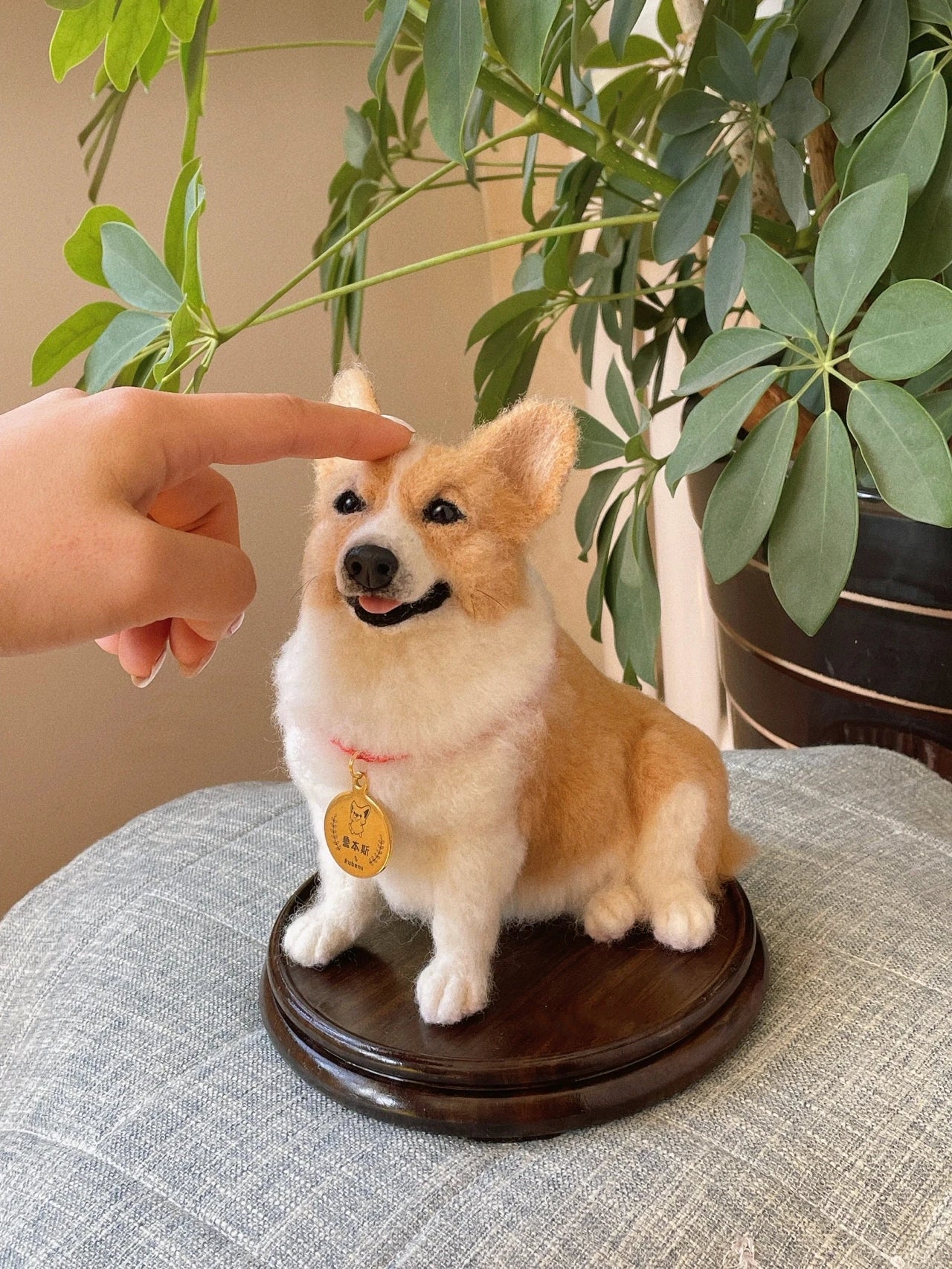
3D Custom Stuffed Animals From Picture – Full Body Pet Portrait
This is the closest PetDecorArt option to a traditional freestanding sculpture. The dog’s entire pose, coat, paws, tail, expression, and markings can be recreated as a three-dimensional needle-felted wool figure.
- Price shown: $499.99 to $1,999.99, depending on size
- Available sizes: 6–8, 8–10, 10–12, 12–14, and 14–16 inches
- Main material: Wool body and coat
- Detail materials: Glass eyes; resin, clay, or wax may be used for ears, nose, paws, tongue, and teeth
- Production timeline shown: Approximately 15–30 days
- Revision policy shown: One-on-one service with unlimited revisions
- Best for: Signature poses, detailed markings, memorial centerpieces, and full-body likeness
Choose this format when your dog’s body shape or usual posture is an important part of their identity. It is especially effective for dogs with recognizable sitting positions, curled tails, short legs, deep chests, fluffy coats, or unusual markings on the paws and back.
View the Full-Body Dog Sculpture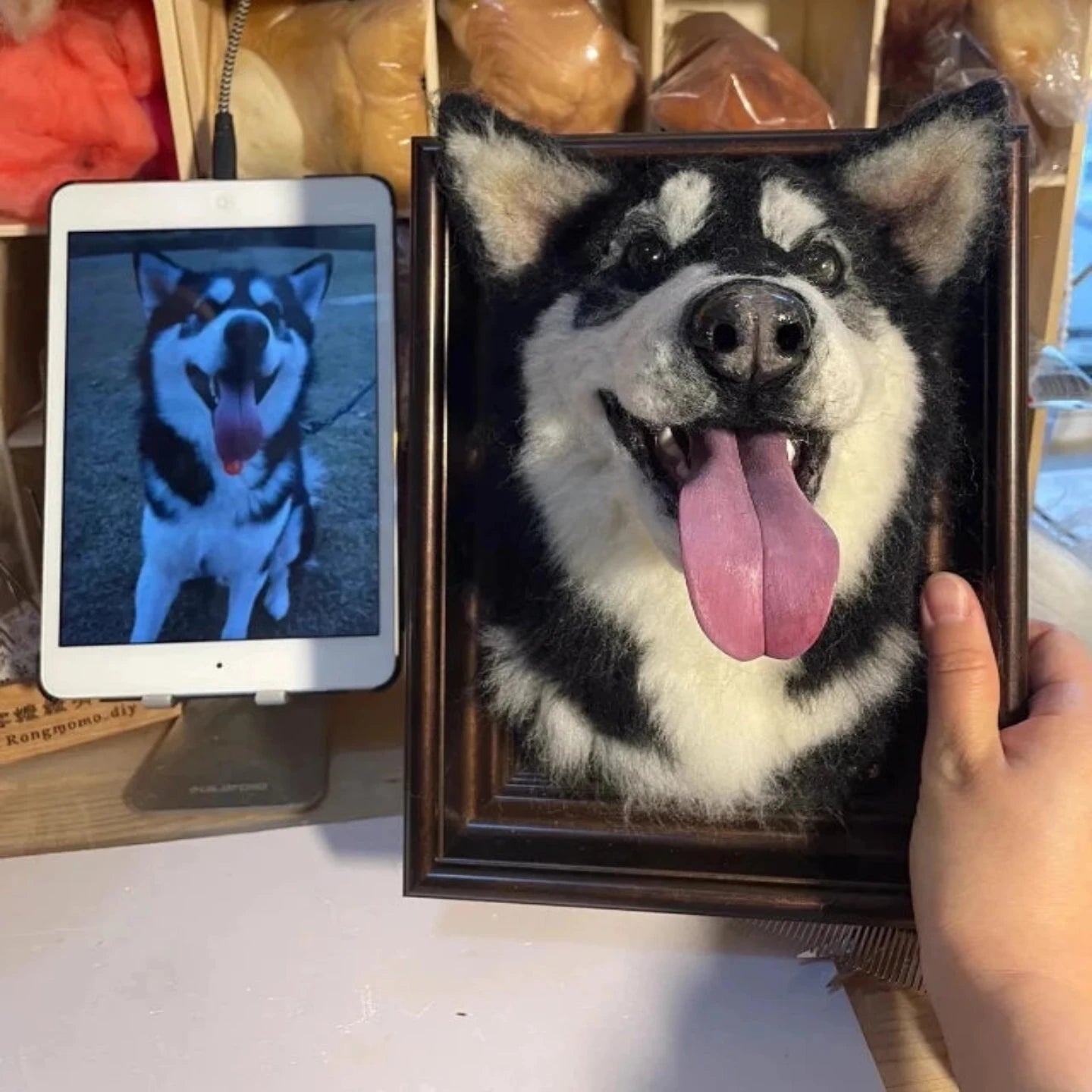
3D Custom Stuffed Animal Clone with Wooden Frame
A framed wool portrait concentrates the detail around the face, ears, chest, and expression. It creates more physical depth than a flat painting but is easier to place on a wall or shelf than a freestanding full-body figure.
- Starting price shown: $249.99
- Design options: Head only or half body
- Frame sizes shown: 6, 7, 8, 10, 12, and 16 inches
- Main material: Handmade wool felt with a wooden frame
- Special customization: The product page states that real whiskers or fur may be included
- Production timeline shown: Approximately 15–30 days
- Best for: Facial likeness, memorial walls, desks, mantels, and smaller rooms
This is often the better choice when the dog’s eyes and expression matter more than reproducing a specific standing or sitting pose. It also removes the need to find a stable tabletop location for a freestanding figure.
View the Framed 3D Wool Portrait
Custom Handcrafted 3D Pet Portrait Clay Ring
This is not a shelf-size dog statue. It is a wearable miniature sculpture built around the dog’s face and front-body form. It suits someone who wants a highly personal piece without committing to a large display item.
- Price shown: $99.99
- Ring sizes shown: 4 through 13
- Material: Hand-shaped and hand-painted clay
- Finish: Protective glazed surface described as water-resistant and durable
- Production time shown: About 2–4 weeks, depending on complexity and the current queue
- Best for: Wearable memorials, small gifts, and owners who prefer a private keepsake
Because the sculpted dog extends beyond a standard smooth ring shape, treat it as handcrafted art. Remove it before activities that may crush, scrape, or repeatedly strike the sculpted portion.
View the Custom Clay Pet Ring| PetDecorArt option | Current price shown | Best detail area | Space needed | Best buyer |
|---|---|---|---|---|
| Full-body 3D wool portrait | $499.99–$1,999.99 | Entire body, posture, tail, paws, coat, and expression | Dedicated shelf, cabinet, table, or display case | Someone who wants the closest full-body representation |
| Framed 3D wool portrait | From $249.99 | Face, ears, eyes, chest, and expression | Wall, desk, mantel, or shelf | Someone who wants dimensional realism with simple display |
| 3D clay pet ring | $99.99 | Miniature face and front-body details | No permanent display area required | Someone who wants a small, wearable reminder |
Browse the broader custom wool pet sculpture collection, clay pet portrait collection, or custom pet portrait collection to compare formats.
How Much Does a Custom Dog Sculpture Cost?
Custom dog sculpture prices can range from under $100 for a small simplified miniature to several thousand dollars for a large, highly detailed, or traditionally cast piece. Material matters, but labor, scale, realism, revision time, and the artist’s workload usually matter just as much.
| Format | Example price or range | What usually affects the price | Source |
|---|---|---|---|
| Small clay or wearable sculptural portrait | Around $50–$200+ | Size, hand painting, facial detail, jewelry hardware, and protective finish | PetDecorArt clay ring |
| Small resin or 3D-printed figurine | About $86–$233 in one current custom example | Figure height, digital modeling, color printing, base, and finishing | Custom resin figurine example |
| Framed 3D wool dog portrait | From $249.99 at PetDecorArt | Frame size, head versus half-body design, fur complexity, and extra physical details | Official product page |
| Full-body needle-felted wool sculpture | $499.99–$1,999.99 at PetDecorArt | Finished height, pose, anatomy, fur length, markings, and detail level | Official product page |
| Large bronze commission | Usually quote-based | Scale, sculpting, mold making, foundry work, casting, finish, shipping, and installation | Bronze commission process |
Price comparisons only make sense when the products include similar work. A low-cost listing may provide a small simplified figure with no proof or revisions. A higher quote may include custom anatomy, a specific pose, detailed coat work, direct communication, multiple revisions, a display base, and approval before shipping.
Questions to ask before comparing two prices
- Is the piece head-only, half-body, or full-body?
- What are the exact finished dimensions?
- Is the pose custom or selected from a standard template?
- Are accessories, a nameplate, or a display base included?
- How many pets are included?
- Will the artist send a proof before shipping?
- How many revisions are included?
- Does the price include framing?
- Are shipping, tax, and rush fees included?
- What happens if the item arrives damaged?
For a broader comparison of two-dimensional and three-dimensional portrait costs, see How Much Does a Dog Portrait Cost?
How to Choose the Right Sculpture Size
Bigger is not automatically more realistic. A larger sculpture gives the artist more room for small markings and fur transitions, but it also requires more display space and may cost considerably more.
| Approximate size | Good location | Best use | What to consider |
|---|---|---|---|
| Under 4 inches | Ring, ornament, small desk area, display box | Portable or symbolic likeness | Fine markings may need to be simplified |
| 6–8 inches | Desk, shelf, bedside table, memorial corner | Compact full-body sculpture | Works well in apartments and smaller displays |
| 8–12 inches | Bookcase, cabinet, mantel, console table | Balanced detail and manageable size | Measure depth as well as height |
| 12–16 inches | Dedicated shelf, side table, display cabinet | Statement memorial or highly detailed replica | Requires a stable, protected display area |
| Life-size | Large interior, entryway, garden, memorial area | Fine-art installation or permanent tribute | Weight, delivery access, base, anchoring, and material become major factors |
Measure the display area before ordering
- Measure the available height, width, and depth.
- Allow space around the sculpture so ears and tails do not touch nearby objects.
- Check whether the shelf can support the weight.
- Keep the piece away from direct sunlight, steam, vents, and areas where it may be knocked over.
- Use painter’s tape or a cardboard outline to preview the size.
Framed pieces also need depth clearance. A three-dimensional wool portrait may extend farther from the frame than a standard photograph.
Can a Sculpture Be Made After My Dog Has Passed Away?
Yes. Many custom dog sculptures are created as memorial pieces. An artist does not need to meet the dog in person if you can provide enough visual information and a clear description of the dog’s personality.
Do not reject an important photo simply because it is not technically perfect. A slightly blurry image may capture the exact expression your family remembers. Use that image for emotional direction, then support it with clearer photos that show coat color, body shape, ears, paws, and tail.
How to build a memorial reference set
- Choose one photo that feels most like your dog.
- Add one clear face photo, even if the expression is less meaningful.
- Add full-body images from both sides when possible.
- Include close-ups of markings that are hidden in the main photo.
- Write down details that photographs do not show accurately.
- Ask family members what physical feature they remember first.
For help creating a larger remembrance display, see How to Make a Pet Memorial and How to Choose a Dog Memorial Portrait.
Can real fur or whiskers be included?
Some artists and product formats allow a small amount of real fur or whiskers to be incorporated. PetDecorArt states that its framed wool portrait may include real whiskers or fur. Confirm this before mailing anything.
- Ask exactly how much material is needed.
- Keep part of the fur or whiskers at home rather than sending everything.
- Place the material in a clean, labeled, sealed bag.
- Use tracked shipping when sending irreplaceable material.
- Ask what happens to unused material.
- Do not mail ashes unless the seller specifically offers and documents that service.
How to Review the Artist’s Proof
A proof is not just a final photograph to admire. It is your chance to catch changes before the piece is packed and shipped.
Proof approval checklist
- Does the body look too tall, short, wide, or narrow?
- Is the head proportional to the body?
- Are the ears the correct height, direction, and shape?
- Are the eyes spaced correctly?
- Is the muzzle too long, too short, too narrow, or too wide?
- Does the nose color match?
- Are major facial patches in the correct position?
- Are chest, back, paw, and tail markings present?
- Does the coat look too light, dark, warm, or cool?
- Is the pose natural for your dog?
- Are the collar and accessories correct?
- Does the expression feel familiar?
How to request revisions clearly
Avoid vague feedback such as “It does not look right.” Use specific comparisons:
- “Please make the muzzle slightly shorter, using photo three as the reference.”
- “The left ear should bend forward at the tip.”
- “The white chest patch should extend farther toward the right shoulder.”
- “The eyes are medium brown, not black.”
- “Please reduce the width of the head slightly.”
- “The tail should curl toward the dog’s left side.”
Marking up the proof image with arrows can help. Keep each revision request connected to a reference photo so the artist does not have to guess.
Common Mistakes to Avoid
1. Ordering from one heavily filtered photo
Filters can change coat temperature, eye color, contrast, and facial proportions. Include unfiltered reference images whenever possible.
2. Choosing a pose that hides important markings
A tightly curled sleeping pose may hide the chest, legs, and tail. Decide whether the pose or the markings matter more.
3. Assuming the artist knows the breed standard
Your dog may not match a textbook breed shape. Ask the artist to follow your dog’s actual proportions rather than a generic breed model.
4. Forgetting that photos change color
Indoor bulbs can turn cream fur yellow and cool shade can make black fur look blue. Tell the artist which image has the most accurate color.
5. Focusing on whiskers before proportions
Fix the silhouette, head shape, ears, eyes, muzzle, and major markings first. Tiny details should come later.
6. Not checking the actual dimensions
“Small,” “medium,” and “large” are not dependable measurements. Review inches or centimeters and measure the display area.
7. Waiting until the last minute
Handmade sculptures may require several weeks before shipping. Holiday periods and complex revisions can extend the schedule.
8. Treating a handmade sculpture like a toy
Wool, clay, glass eyes, resin details, wires, frames, and small components are intended for decorative use. Keep the finished piece away from chewing pets and young children.
9. Ignoring the cancellation terms
Custom work may become nonrefundable or subject to a production fee after the artist begins. Read the product-specific return and cancellation information before ordering.
10. Requesting too many conflicting features
Combining the head from one age, body from another age, coat color from summer, and pose from a different dog can create confusion. Explain exactly how the references should be combined.
How to Care for a Custom Dog Sculpture
Care depends on the material. Always follow the artist’s product-specific instructions first.
| Material | Routine care | Avoid | Best display location |
|---|---|---|---|
| Needle-felted wool | Remove loose dust gently with clean, dry air or a very soft brush | Water, rubbing, vacuum contact, pulling fibers, direct sun, and high humidity | Protected shelf, cabinet, frame, or display case |
| Clay | Dust with a soft dry cloth or brush and handle by the strongest area | Drops, crushing, harsh chemicals, and pressure on ears or tails | Stable shelf, jewelry box, or protected display area |
| Resin or 3D print | Use a soft cloth and follow the maker’s cleaning instructions | High heat, abrasive cleaners, and prolonged direct sun unless rated for it | Interior shelf or case |
| Bronze | Follow the sculptor or foundry’s instructions for the specific finish | Unapproved polishing products that may alter the patina | Indoor or outdoor location approved for the finish and base |
| Framed 3D portrait | Dust the frame and protect the sculpted surface from contact | Bathrooms, kitchens, damp basements, and direct HVAC airflow | Interior wall or shelf away from heat and moisture |
Keep the original packaging if possible. A fitted box is useful if you move, store, or transport the piece later.
Frequently Asked Questions
Can someone make a sculpture of my dog from one photo?
It may be possible, especially for a head-only portrait, but one photo leaves the artist guessing about body shape, side markings, tail, ears, and hidden features. A full-body sculpture usually benefits from front, side, rear, face, and coat-detail photos.
How many photos should I send for a custom dog sculpture?
A focused set of about six to ten useful photos is a good starting point. Include a clear front view, both sides, the back and tail, close-ups of the eyes and markings, and one photo that captures your dog’s normal personality.
Can a sculpture be made if my dog has passed away?
Yes. Memorial sculptures are commonly created from existing photos. Use one emotionally meaningful image for the expression and add clearer supporting photos for color, body proportions, markings, and coat texture.
What material looks most like real dog fur?
Needle-felted wool is one of the strongest choices for reproducing visible fur texture. Fibers can be layered and directed to represent short coats, curls, long feathering, fluffy cheeks, and color transitions. Read the pet portrait materials guide for a broader comparison.
How much does it cost to have a sculpture made of a dog?
Small simplified clay or resin figures may cost under $200, while detailed framed or full-body wool sculptures can cost several hundred dollars or more. PetDecorArt currently lists its framed wool portrait from $249.99 and its full-body wool portrait from $499.99 to $1,999.99, depending on size. Large bronze commissions are normally quote-based.
How long does a custom dog sculpture take?
The schedule depends on material, size, complexity, revisions, and the artist’s order queue. PetDecorArt currently lists approximately 15–30 days of production for its full-body and framed wool portraits. Shipping time is additional.
Can the artist copy my dog’s exact pose?
Often, yes, especially with a full-body commission. The pose must be visible clearly enough for the artist to understand the legs, back, neck, tail, and weight distribution. Send several views of the same pose when possible.
Can a collar, tag, bandana, or favorite toy be included?
Many artists can reproduce accessories when they are clearly visible in the reference photos. State whether the accessory is essential, provide close-up images, and confirm whether it affects the price.
Can two dogs be included in one sculpture?
It depends on the artist and product format. Some framed pieces or custom compositions may support multiple pets, while a freestanding full-body product may require one sculpture per dog. Ask how size, pose, price, and revision time change when adding another pet.
Can real dog fur or whiskers be used?
Some makers allow a small amount of real fur or whiskers. PetDecorArt states that its framed wool portrait may include these materials. Confirm the process before sending anything irreplaceable and keep a portion at home.
What happens if the finished sculpture does not look like my dog?
Review the seller’s revision process before ordering. When a proof is provided, compare the silhouette, head shape, ears, eye spacing, muzzle, markings, and expression. Request specific changes using marked-up images and reference-photo numbers.
Is a custom needle-felted dog sculpture a stuffed toy?
No. Although it is made with wool and may be described as a stuffed-animal-style portrait, a detailed needle-felted sculpture is decorative art. It may contain glass, resin, clay, wax, wire, or other small components and should not be given to a pet or young child as a toy.
What size dog sculpture is best for a memorial shelf?
A 6–10 inch full-body figure or a 6–10 inch framed portrait usually fits comfortably on a shelf, mantel, or bedside table. Measure the available height, width, and depth before choosing.
Should I choose a realistic or stylized dog sculpture?
Choose realism when exact markings, facial structure, and memorial accuracy matter most. Choose a stylized design when you want a playful gift, exaggerated expression, simplified shape, or lower-cost miniature. Ask to see finished examples in the same style before ordering.
Turn Your Dog’s Photos Into a Handmade Sculpture
Start by choosing the type of keepsake you want, then gather clear photos of your dog’s face, body, markings, and favorite expression. Compare the full-body, framed, and miniature options before deciding which format fits your space and budget.
View Custom Wool Pet Sculptures Explore All Custom Pet Portraits Ask About a Custom Design


